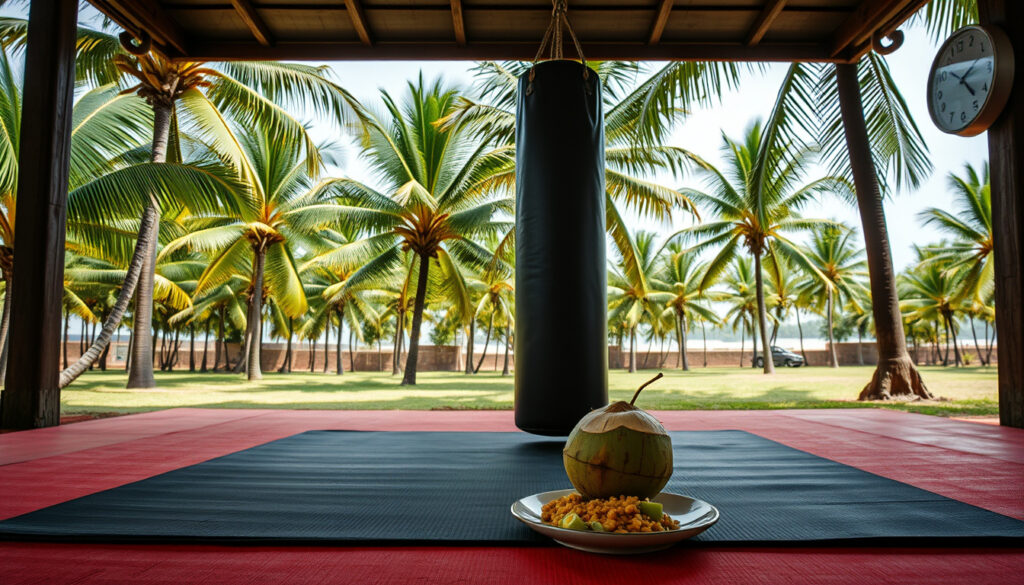
MMA Fighter Guide: Sri Lanka Training, Nutrition & Schedule
If you’re a mixed martial artist in Sri Lanka, you’ve probably noticed a gap between your ambition and the official support structures around you — the sport is growing fast, but the federation recognition is still catching up. That’s why we’ve put together this Sri Lanka-specific guide: to help you train smarter, eat better, and plan your fight schedule with the best available information on the ground.
Institute of Sports Medicine nutrition page: Last updated March 2026 ·
SLMMA address: 158/2B, Saranankara Road, Dehiwela ·
2019 status: No official MMA federation recognised
Quick snapshot
- The Sri Lanka Mixed Martial Arts Association is listed as the representative body by the Asian Mixed Martial Arts Association (Asian Mixed Martial Arts Association)
- The Institute of Sports Medicine has a dedicated Performance Nutrition page (Institute of Sports Medicine)
- Whether the Sports Ministry has officially recognised MMA since 2019 (Roar Media (Sri Lankan feature outlet))
- Exact fight schedules and event calendars for Sri Lankan MMA (Roar Media (Sri Lankan feature outlet))
- 2019: Sri Lanka’s Sports Ministry had federations for other martial arts but not MMA (Roar Media (Sri Lankan feature outlet))
- 2025-02-24: Journal article on national-level athletes published (Journal of Nutrition and Food Security / SLJOL)
- 2026-03-31: Institute of Sports Medicine nutrition page updated (Institute of Sports Medicine)
- Push for formal federal recognition of MMA in Sri Lanka
- Development of local fight-camp nutrition protocols based on official guidance
The table below consolidates the verified facts used in this guide, with direct links to sources.
| Fact | Detail | Source |
|---|---|---|
| SLMMA address | 158/2B, Saranankara Road, Dehiwela | Asian Mixed Martial Arts Association |
| ISM Performance Nutrition page | Exists and updated 2026-03-31 | Institute of Sports Medicine |
| 2019 federation status | No MMA federation recognised | Roar Media (Sri Lankan feature outlet) |
| Carb-rich pre-training | Recommended before training | The Morning (Sri Lankan daily newspaper) |
| Protein distribution | Across all three meals | The Morning (Sri Lankan daily newspaper) |
| Don’t skip meals | Advice for athletes | The Morning (Sri Lankan daily newspaper) |
| Hydration guidance | Weigh before/after, replace 0.5L per 0.5kg lost | The Morning (Sri Lankan daily newspaper) |
| Supplements caution | Useful if iron deficiency suspected; blood test recommended | The Morning (Sri Lankan daily newspaper) |
| Dietary assessment | Recommended for national teams by qualified nutritionist | Nutrition Society of Sri Lanka |
| Anti-doping education | Essential for players and officials | Nutrition Society of Sri Lanka |
The State of MMA in Sri Lanka: Organisations and Recognition
MMA in Sri Lanka operates in a curious middle ground. The Sri Lanka Mixed Martial Arts Association is listed by the Asian Mixed Martial Arts Association (official continental body) as the national representative, with a physical address in Dehiwela. Yet a 2019 report from Roar Media (Sri Lankan feature outlet) noted that the Sports Ministry had federations for several martial arts — but not for MMA. The status of official recognition since then remains unclear, with no public update from the Ministry.
The implication: Sri Lankan fighters operate in a semi-organised space. The association exists, but without full federal backing, access to government sports funding and structured development pathways is limited.
Official Nutrition Guidance for Sri Lankan Fighters
Despite the organisational gap, Sri Lanka’s sports nutrition infrastructure is surprisingly robust. The Institute of Sports Medicine (government-linked sports medicine institution) maintains a Performance Nutrition page, last updated on 31 March 2026 — a clear signal that official support for athlete nutrition is active. The Nutrition Society of Sri Lanka (professional body for dietitians and nutritionists), in its newsletter, advises that national teams should undergo regular dietary assessment by a qualified nutritionist or dietician, and that team physicians should coordinate with the Institute of Sports Medicine and the Ministry of Sports.
What this means: MMA fighters in Sri Lanka have a formal channel to get professional nutrition support — if they can access it through the national team framework or through the Institute’s services.
Sri Lankan MMA fighters have more official nutrition backing than the sport’s federal recognition suggests. The Institutes are ready — the question is whether the fighters can reach them.
The key is to reach out to the Institute of Sports Medicine directly to inquire about athlete services.
Fight Camp Nutrition: What the Experts Say
For a fighter preparing in Sri Lanka’s tropical climate, specific nutrition advice is available from local sources. Guidance published by The Morning (Sri Lankan daily newspaper) outlines key principles:
- Eat carbohydrate-rich meals or snacks before training to fuel performance.
- Distribute protein across all three main meals, not just dinner.
- Never skip meals — consistent energy intake is critical for weight management and recovery.
A 2026-04-17 article on fight-camp nutrition provides a structured week-by-week approach to fueling, though the full details are not publicly indexed. The general pattern is clear: periodised nutrition aligned with training load.
The trade-off: Sri Lankan fighters need to balance these guidelines with local food availability and traditional eating patterns. Rice-based meals are carb-rich, but protein sources like fish and dhal need careful distribution.
How to Fuel for a Fight Camp in Sri Lanka: A Step-by-Step Guide
- Assess your baseline. Weigh yourself before and after training to estimate fluid loss.
- Plan pre-training meals around carbohydrates — rice, roti, or fruit — 2–3 hours before session.
- Include a protein source (fish, chicken, eggs, lentils) at each meal.
- Hydrate during training with water and, for sessions over 60 minutes, simple carbohydrates periodically.
- After training, replace fluids: about 0.5 litres per 0.5 kilogram lost.
- Consider supplementation only if you suspect a deficiency — get a blood test first.
The pattern: periodised nutrition aligned with training load is essential for fight camp preparation.
Hydration and Supplementation for Local Conditions
Sri Lanka’s heat and humidity make hydration a top priority for MMA fighters. The guidance from The Morning (Sri Lankan daily newspaper) is practical: weigh yourself before and after each session, and replace roughly 0.5 litres of fluid for every 0.5 kilogram lost. During longer training sessions, the same source recommends using simple carbohydrates periodically — a strategy that aligns with international sports nutrition standards.
On supplements, the advice is cautious: vitamins and minerals may be useful, especially where iron deficiency is suspected in female athletes. But the guidance stresses that athletes should seek blood testing before supplementing, and that a qualified nutritionist should oversee any regimen. The Nutrition Society of Sri Lanka (professional body for dietitians and nutritionists) reinforces this by calling for regular dietary assessment for national team athletes.
The catch: without a dedicated MMA federation, few fighters have access to the national team nutritionist pathway. Individual fighters may need to consult private nutritionists or reach out to the Institute of Sports Medicine directly.
Fighters who skip pre-training carbs or fail to hydrate properly in Sri Lanka’s climate risk a significant drop in performance and increased injury risk. The official guidance is clear — but access to professional assessment remains the bottleneck.
The solution: fighters should prioritize hydration and seek professional advice on supplementation.
What About Fight Schedules and Events?
One of the biggest challenges for Sri Lankan MMA fighters is the lack of a public, consistent fight calendar. Unlike countries with established MMA federations that publish annual schedules, Sri Lanka’s events are often organised by private promoters and announced on short notice. The Asian Mixed Martial Arts Association (continental governing body) lists the SLMMA as the national representative, but no official event calendar is available on their site for Sri Lanka.
A 2019 article from Roar Media (Sri Lankan feature outlet) documented the evolution of Colombo fight nights, noting that the scene was building momentum but lacked institutional support. As of 2025, the situation remains fluid — fighters must rely on word-of-mouth, social media, and connections with local gyms to find bouts.
The pattern: without a centralised federation, fight scheduling is ad hoc. This makes it harder for fighters to periodise training and nutrition for specific events.
Clarity: What We Know and What Remains Unclear
Confirmed facts
- The SLMMA is listed by the Asian Mixed Martial Arts Association
- Institute of Sports Medicine has a Performance Nutrition page
- Carb-rich pre-training, protein distribution, hydration advice available from The Morning (Sri Lankan daily newspaper)
- Nutrition Society of Sri Lanka recommends dietary assessment for national teams
- Anti-doping education is essential for officials and players
What’s unclear
- Whether the Sports Ministry now recognises MMA officially
- The exact frequency and schedule of local MMA events
- Whether the SLMMA offers structured training programs
- How fighters can access the Institute of Sports Medicine’s nutrition services without a national team affiliation
- Whether the Nutrition Society’s dietary assessment recommendations are accessible to MMA fighters without a national team affiliation
The situation remains fluid, but the available resources are clear.
Expert Perspectives
“Regular dietary assessment by a qualified nutritionist or dietician is essential for national team athletes.”
— Nutrition Society of Sri Lanka, official newsletter
“Our Performance Nutrition page provides evidence-based guidance for athletes in Sri Lanka, including hydration and meal timing.”
— Institute of Sports Medicine, Performance Nutrition page
“Athletes should not skip meals and should distribute protein throughout all three meals.”
— The Morning, sports nutrition feature
“Colombo’s fight nights were building momentum, but the lack of a formal federation meant fighters had to rely on private promoters.”
— Roar Media, 2019 feature on Colombo MMA
For Sri Lankan MMA fighters, the path forward is a mix of existing resources and missing infrastructure. The official nutrition guidance is world-class, but the organisational framework to support a full fight calendar is still developing. The takeaway: use the nutrition tools that are available — the Institute of Sports Medicine and the Nutrition Society’s guidance — while continuing to push for formal federal recognition. Without that, Sri Lankan fighters will continue to face scheduling and funding gaps.
Related reading
- Daniel Cormier: UFC Record, Career, and Hall of Fame Legacy — Learn from one of the greatest MMA champions how structured training and nutrition shaped his career.
- Nathan Cleary: Salary, Relationship & Career Facts — While a rugby league athlete, Cleary’s elite conditioning offers parallels for combat sports athletes.
ism.gov.lk, linkedin.com, repository.wyb.ac.lk, pmc.ncbi.nlm.nih.gov, linkedin.com, 369mmafit.com
Frequently asked questions
Is there an official MMA federation in Sri Lanka?
The Sri Lanka Mixed Martial Arts Association is listed by the Asian Mixed Martial Arts Association as the national representative, but it is not yet clear whether the Sports Ministry has officially recognised it as a federated body.
Where can I find official sports nutrition guidance in Sri Lanka?
The Institute of Sports Medicine (ISM) has a Performance Nutrition page at ism.gov.lk/performance-nutrition with evidence-based advice for athletes.
What should I eat before a training session in Sri Lanka?
According to guidance from The Morning, eat a carbohydrate-rich meal or snack 2–3 hours before training. Rice, roti, or fruit are good options.
How much water should I drink during training?
Weigh yourself before and after training. Replace roughly 0.5 litres of fluid for every 0.5 kilogram lost. During longer sessions, consider simple carbohydrates as well.
Do I need supplements as an MMA fighter in Sri Lanka?
Only if you have a confirmed deficiency. The Morning recommends getting a blood test first. Iron deficiency is more common in female athletes, so women should pay special attention.
How can I find upcoming MMA events in Sri Lanka?
There is no centralised public calendar. Follow local gyms, the SLMMA’s social media, and promoter announcements. The scene is still building institutional support.
Who can I contact for professional nutrition advice?
The Institute of Sports Medicine (ISM) and the Nutrition Society of Sri Lanka can connect you with qualified nutritionists and dieticians. Contact the ISM via their website for athlete services.
More related posts
 Home and Contents Insurance 2026: Compare Costs
 Pacquiao vs Barrios: Who Won, Scorecards, Purse & Next Fight
 Eden Sher: Biography, Husband, Children, and FAQs
 Temple Grandin: Biography, Autism, Inventions, and Legacy
 Real Housewives of Beverly Hills – Season 14 Cast and Guide
 Alan Rickman: Cause of Death, Life, Legacy, and Tributes
 Ping Pong Table Buying Guide Ireland: Price & Tips
 Peter Dinklage: Biography, Net Worth, Diagnosis, Family & More