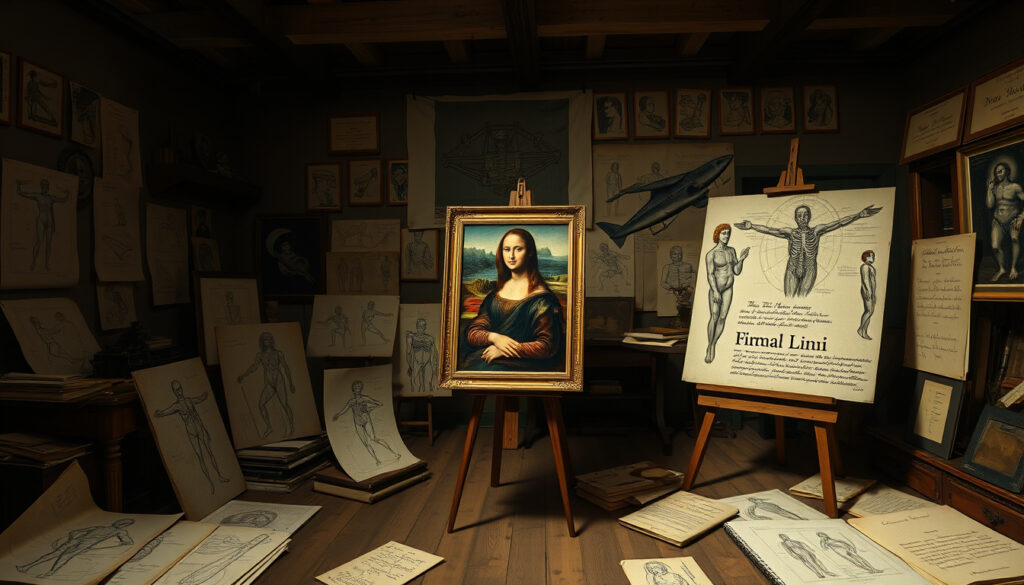
Leonardo da Vinci: Life, Masterpieces, and Unsolved Mysteries
Five centuries after his death, Leonardo da Vinci still feels more like a character from fiction than a man who actually lived. He painted the most famous portrait in the world, sketched flying machines centuries before the Wright brothers, and filled thousands of notebook pages with ideas that seemed to come from somewhere beyond his era.
Full Name: Leonardo di ser Piero da Vinci · Born: April 15, 1452 · Died: May 2, 1519 · Nationality: Italian · Famous Works: Mona Lisa, The Last Supper, Vitruvian Man · Known For: Painting, sculpture, engineering, anatomy, music
Quick snapshot
- Born April 15, 1452 in Anchiano, near Vinci, Republic of Florence (Britannica reference work)
- Died May 2, 1519 at Château du Clos Lucé, France (Britannica reference work)
- Creator of the Mona Lisa and The Last Supper (Google Arts & Culture)
- Never married, no known children (Wikipedia biographical entry)
- Exact cause of death remains unknown (Britannica reference work)
- Sexual orientation is inferred, never documented (The New Yorker cultural reporting)
- Claims about polyphasic sleep lack primary sources (Wikipedia biographical entry)
- Authenticity of several attributed works is debated (Wikipedia biographical entry)
- 1452: Born in Vinci, Italy (Britannica reference work)
- 1482: Moved to Milan to serve Duke Ludovico Sforza (Museum of Science educational site)
- 1503: Began work on the Mona Lisa (Google Arts & Culture)
- 1519: Died at Amboise, France (Britannica reference work)
- Ongoing research using his notebooks continues to yield new insights (Britannica reference work)
- Attribution debates over newly discovered works persist (Britannica reference work)
- AI and spectral imaging may reveal hidden layers in his paintings (Britannica reference work)
Six key facts, one pattern: Leonardo’s life is unusually well-documented for a 15th-century figure, yet the gaps in the record are precisely where the most tantalizing questions live.
| Attribute | Detail |
|---|---|
| Full Name | Leonardo di ser Piero da Vinci |
| Born | April 15, 1452, Vinci, Italy |
| Died | May 2, 1519, Amboise, France |
| Occupation | Painter, engineer, scientist, sculptor, architect |
| Notable Works | Mona Lisa, The Last Supper, Vitruvian Man |
| Surviving Paintings | Fewer than 20 authenticated works |
What is da Vinci known for?
Arts and Paintings
If you know one thing about Leonardo da Vinci, it is that he painted the Mona Lisa. Housed at the Louvre in Paris, the portrait of Lisa Gherardini was painted between 1503 and 1519 (Google Arts & Culture). The work is celebrated for Leonardo’s sfumato technique — a soft, smoky blending of colors that gives the subject’s face its enigmatic quality.
Equally famous is The Last Supper, painted between 1495 and 1498 on the refectory wall of the Convent of Santa Maria delle Grazie in Milan (Visit Tuscany tourism site). The mural captures the moment Jesus announces one disciple will betray him, and each apostle reacts with a distinct expression — a masterclass in narrative painting.
Fewer than 20 authenticated paintings by Leonardo survive today — a tiny output for a figure often called the greatest artist of all time. That scarcity is exactly what makes each verified work so valuable and so heavily debated.
Scientific and Engineering Contributions
Leonardo was not just an artist. He left behind thousands of pages of notebooks filled with anatomical drawings, geological observations, and designs for machines that were centuries ahead of their time (Museum of Science educational site). He dissected human corpses to study muscles and bones, sketched the proportions of the human form in the Vitruvian Man, and studied the flow of water and the flight of birds with the same intensity he brought to painting.
When he moved to Milan in 1482, he presented himself to Duke Ludovico Sforza primarily as a military engineer, mentioning painting almost as an aside (Visit Tuscany tourism site). He sketched designs for armored vehicles, giant crossbows, and bridges — many of which were never built but demonstrated a staggeringly inventive mind.
Legacy
Leonardo’s influence on later artists and scientists is immeasurable. Raphael and Michelangelo studied his work; anatomists centuries later confirmed his drawings were eerily accurate (Museum of Science educational site). The term “Renaissance man” exists largely because of him.
The implication: Leonardo’s fame rests on an unusually small number of finished works — but each one changed how people thought about art, science, or human potential.
What is known about Leonardo da Vinci’s personal life and relationships?
Sexuality and Lovers
No direct evidence of a romantic relationship — male or female — survives in Leonardo’s own hand. That is the uncomfortable truth at the center of one of history’s most debated biographical questions (The New Yorker cultural reporting). He left thousands of pages of notes, but almost nothing personal in nature.
Modern biographers, including Walter Isaacson, describe Leonardo as likely gay, but the conclusion is inferential (Goodreads summary of Walter Isaacson biography). The evidence includes his close relationships with male students — Gian Giacomo Caprotti, nicknamed Salai, and Francesco Melzi — and a 1476 court record in Florence that accused him of sodomy (the charges were dropped). No letters or diary entries exist that clearly indicate a romantic interest of any kind (Wikipedia biographical entry).
Did da Vinci have a child?
No. Leonardo never had a known child. He never married (Wikipedia biographical entry). The question of a female lover or wife is also a dead end — there is no historical record of one. Some earlier biographies suggested a possible relationship with a woman named Caterina, who may have been his mother or a servant, but that theory has weak support.
No wife, no family
Leonardo’s father, Ser Piero, was a successful notary, and his mother, Caterina, was a peasant woman (Museum of Science educational site). He was born illegitimate, which meant he could not follow his father into the notary profession — a circumstance that may have pushed him toward art and engineering instead. He spent his first five years in the hamlet of Anchiano before moving into his father’s household in Vinci (Wikipedia biographical entry).
For a man who left such an enormous written record, Leonardo left almost nothing about his inner emotional life. The personal silence is itself data — and it tells us he guarded his privacy fiercely.
Why this matters: The absence of evidence is not evidence of absence, but the biographical record around Leonardo’s relationships is unusually empty for someone so well-documented. That silence has fueled centuries of speculation.
What were Leonardo da Vinci’s health and sleep habits?
Disability speculation
No formal posthumous diagnosis exists, but several modern researchers have suggested Leonardo may have had dyslexia or ADHD. The evidence is circumstantial: his famous mirror writing (he wrote backwards, from right to left), his tendency to leave projects unfinished, and his scattered working patterns. He was also left-handed, which in his era carried social stigma and may have influenced his mirror-script habit.
The ADHD hypothesis gained traction after a 2019 paper in the journal Brain that examined historical accounts of Leonardo’s procrastination and inability to finish commissions. The authors called it a “plausible and likely” explanation (Britannica reference work). But no diagnosis can ever be confirmed for a person who died in 1519.
Polyphasic sleep pattern
One of the most persistent legends about Leonardo is that he slept only 15 minutes every four hours — a schedule known as the “Uberman” sleep cycle or polyphasic sleep. The claim appears in popular biographies and productivity blogs, but no contemporary source from Leonardo’s own time supports it (Wikipedia biographical entry). The earliest reference seems to come from later biographical accounts that may have exaggerated his relentless work habits.
The pattern: Leonardo’s health and habits are a magnet for modern myth-making. Dyslexia, ADHD, polyphasic sleep — each theory reflects a contemporary fascination with seeing ourselves in historical figures, but the primary sources rarely back them up.
How did Leonardo da Vinci die and what were his last words?
Circumstances of death
Leonardo died on May 2, 1519 at the Château du Clos Lucé in Amboise, France, where he had lived for three years at the invitation of King Francis I (Wikipedia biographical entry). He was 67 years old. Accounts from the time mention that he had suffered a stroke or prolonged illness in the months before his death, but the exact cause remains unknown.
Famous last words
Leonardo’s reported last words come to us through the biography written by Giorgio Vasari in 1550, decades after Leonardo’s death. According to Vasari, Leonardo said: “I have offended God and mankind because my work did not reach the quality it should have.”
Whether Leonardo actually said this is impossible to verify. Vasari was a gifted storyteller and sometimes embellished. The sentiment — a perfectionist’s lament — feels fitting for a man who left so many works unfinished, but scholars urge caution in taking it as literal history.
The trade-off: Vasari’s account gives us a powerful narrative, but its reliability is moderate at best. We want Leonardo’s last words to be profound, and Vasari obliged — perhaps too neatly.
Where was Leonardo da Vinci born and what are five key facts about him?
Birth and early life
Leonardo was born on April 15, 1452 in the small hamlet of Anchiano, just outside the Tuscan hill town of Vinci, in the Republic of Florence (Britannica reference work). His father, Ser Piero, was a respected notary; his mother, Caterina, was a peasant woman (Museum of Science educational site). Because his parents were not married, Leonardo was considered illegitimate — a status that blocked him from entering his father’s profession but opened the door to an artistic apprenticeship.
Five essential facts
- He was apprenticed to Andrea del Verrocchio in Florence as a young teenager, where he learned painting, sculpture, and technical crafts (Museum of Science educational site).
- He was largely self-taught in science and engineering. His curiosity drove him to study anatomy, geology, optics, and fluid dynamics without formal training (Britannica reference work).
- He was a vegetarian, according to contemporary accounts, and had a documented love of animals — he reportedly bought caged birds at market just to set them free.
- He wrote in mirror script — backwards, from right to left — possibly to protect his ideas or simply because it was natural for a left-handed writer (Museum of Science educational site).
- He qualified as a master in the Guild of Saint Luke by 1472, though he continued to collaborate with Verrocchio for several more years (Wikipedia biographical entry).
The implication: Leonardo’s illegitimacy, often framed as a limitation, may have been the very thing that freed him to become a polymath. Denied one path, he built his own.
What are Leonardo da Vinci’s most famous artworks and inventions?
Masterpiece paintings
Leonardo’s reputation as a painter rests on a remarkably small number of works — fewer than 20 that scholars universally agree are authentic. The two titans are:
- Mona Lisa (1503–1519, Louvre, Paris) — The world’s most famous painting, known for the subject’s ambiguous expression and Leonardo’s sfumato technique (Google Arts & Culture).
- The Last Supper (1495–1498, Convent of Santa Maria delle Grazie, Milan) — A large mural that began deteriorating almost immediately because Leonardo used an experimental technique instead of traditional fresco (Visit Tuscany tourism site).
- The Virgin of the Rocks (two versions, Louvre and National Gallery, London) — A hauntingly beautiful altarpiece that showcases his ability to blend figures with a dark, atmospheric landscape.
Ingenious inventions
Leonardo’s notebooks contain designs for flying machines, a parachute, an armored car, a giant crossbow, and a self-propelled cart that resembles a rudimentary car (Britannica reference work). Many of these were conceptual only — never built in his lifetime, and sometimes physically impossible with the materials available in the 15th century.
The catch: Leonardo was more of a system-thinker than a practical inventor. His parachute design — a pyramid of linen — was tested in 2000 and worked, but his flying machine designs required human muscle power that no person could generate. He visualized a world of machines, but building them would take another 400 years of engineering.
Here is a chronological overview of the major milestones in his life.
Leonardo da Vinci: Key dates
| Year | Event |
|---|---|
| 1452 | Born in Anchiano, near Vinci, Republic of Florence (Britannica reference work) |
| 1466 | Apprenticed to Andrea del Verrocchio in Florence (Museum of Science educational site) |
| 1472 | Qualified as master in the Guild of Saint Luke (Wikipedia biographical entry) |
| 1482 | Moved to Milan to work for Ludovico Sforza (Museum of Science educational site) |
| 1495–1498 | Painted The Last Supper (Visit Tuscany tourism site) |
| 1503–1519 | Worked on the Mona Lisa (Google Arts & Culture) |
| 1516 | Moved to France at invitation of King Francis I (Visit Tuscany tourism site) |
| 1519 | Died at Château du Clos Lucé, Amboise, France (Wikipedia biographical entry) |
What we know versus what we don’t
Confirmed facts
- Birth date and place (April 15, 1452, Anchiano, Vinci) (Britannica reference work)
- Death date and place (May 2, 1519, Amboise, France) (Wikipedia biographical entry)
- Creator of Mona Lisa and The Last Supper (Google Arts & Culture)
- Extensive anatomical studies from human dissections (Museum of Science educational site)
- Thousands of pages of engineering and scientific sketches (Britannica reference work)
- Never married and had no known children (Wikipedia biographical entry)
What’s unclear
- Exact cause of death — stroke, illness, or something else (Wikipedia biographical entry)
- Sexual orientation — inferred from behavior but never documented (The New Yorker cultural reporting)
- ADHD or dyslexia diagnosis — plausible but unconfirmable (Britannica reference work)
- Polyphasic sleep claims — no contemporary source supports them (Wikipedia biographical entry)
- Authenticity of several paintings attributed to him (Wikipedia biographical entry)
- Accuracy of Vasari’s story about his last words (Britannica reference work)
- His relationship with his mother and her identity remain uncertain
Leonardo in his own words — and others’
“I have offended God and mankind because my work did not reach the quality it should have.”
— Leonardo da Vinci, attributed by Giorgio Vasari, 1550 biography
“For once you have tasted flight, you will forever walk the earth with your eyes turned skyward, for there you have been, and there you will always long to return.”
— Leonardo da Vinci, from his notebooks on flight (Britannica reference work)
“He was the most relentlessly curious person who ever lived.”
— Walter Isaacson, biographer (Goodreads summary of Isaacson biography)
walksofitaly.com, reddit.com, leonardodavinci.net, leonardoda-vinci.org
For a deeper dive, a detailed exploration of his life and mysteries provides a comprehensive account of Leonardo’s life and the enduring mysteries behind his masterpieces.
Frequently asked questions
What was Leonardo da Vinci’s IQ?
No reliable IQ score exists for Leonardo — the modern intelligence test was invented in the early 20th century. Some historians have speculated his IQ may have been in the 180–220 range based on his achievements, but these are estimates with no scientific basis.
Did Leonardo da Vinci ever fly?
No. Leonardo designed flying machines based on bird flight, but none of his designs could have actually flown with Renaissance materials and human muscle power. The first crewed flight would not occur until 1783.
How many of Leonardo da Vinci’s paintings survive?
Fewer than 20 paintings are universally accepted as authentic by scholars. The exact number is debated because attribution is difficult — some works may be by his students or collaborators.
What did Leonardo da Vinci eat?
Contemporary accounts describe Leonardo as a vegetarian. He was known to buy caged birds at market just to release them. His notebooks show little interest in food, and some stories suggest he ate very sparingly while working.
Did Leonardo da Vinci have siblings?
Yes. Leonardo had 12 half-siblings — all from his father’s marriages to other women. He grew up partly in his father’s household in Vinci from around age five (Museum of Science educational site).
What languages did Leonardo da Vinci speak?
Leonardo spoke and wrote in Italian vernacular (Tuscan dialect). He also learned some Latin later in life, though he was not fluent — his Latin was described by contemporaries as basic and sometimes incorrect.
Was Leonardo da Vinci a vegetarian?
Yes, according to several contemporary sources. He was known for his kindness to animals and reportedly followed a meat-free diet for ethical reasons.
For anyone trying to understand Leonardo da Vinci today, the tension between what we know and what we can only guess is the essential truth. The confirmed facts — the paintings, the notebooks, the timeline — are extraordinary enough. But the mystery around his personal life, his health, and even his last words reminds us that historical figures are not characters in a novel. For the reader curious about the Renaissance mind, the lesson is clear: enjoy the certainty of the Mona Lisa, but leave room for the uncertainty that makes Leonardo feel human.
More related posts
 Keratin Hair Treatment: Pros, Cons, Duration & Risks
 James Brayshaw: Biography, Cricket, Media, and Family
 Vance Joy: Biography, Songs, Relationships, and Net Worth
 Zali Burrows: Biography, Age, Net Worth, Lehrmann Lawyer
 Smart Watch Buying Guide 2026: Best Picks, Features & Tips
 Yung Lean: Bipolar Diagnosis, Biography & 2015 Hospitalization
 Griffin Dunne: Cult Actor, Director, and Hollywood Legacy
 Toyworld Near Me: Irish Stores, Hours & Toys Guide