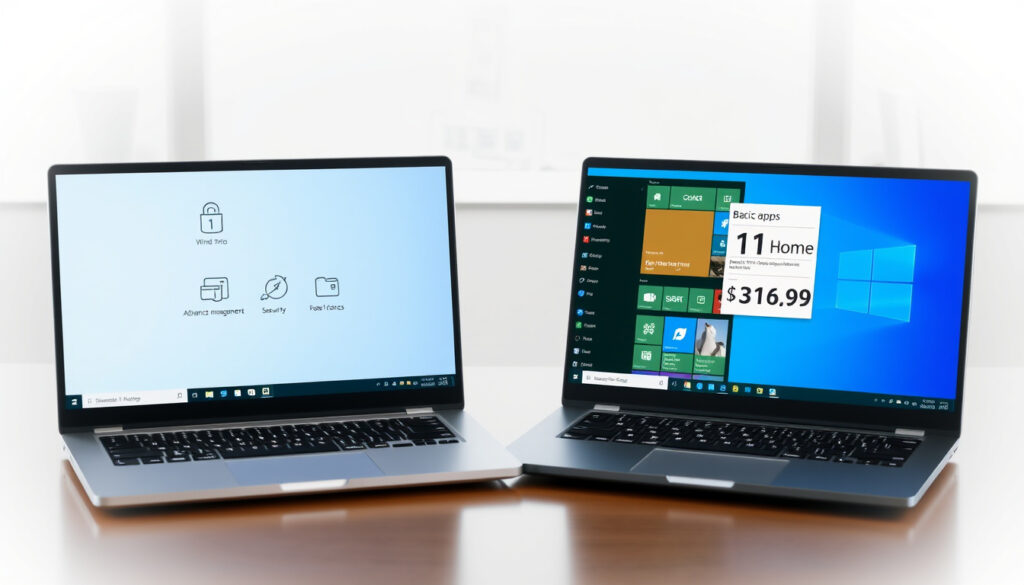
Windows 11 Pro vs Home: Differences, Pricing and Verdict
Anyone who’s shopped for a new PC lately has seen the Windows 11 Home vs Pro choice at checkout. The price gap is modest — Microsoft’s official upgrade from Home to Pro costs $99.99 — but the feature gap can feel like a maze. This article breaks down exactly what each edition offers, where the extra money goes, and whether the upgrade is actually worth it for your setup.
Price gap (Home → Pro): $99.99 ·
Key security exclusive to Pro: BitLocker device encryption ·
Max RAM: 2 TB (Pro) vs 128 GB (Home)
Quick snapshot
- BitLocker full-disk encryption is exclusive to Pro (Microsoft comparison page)
- Hyper-V and Windows Sandbox are Pro-only (Microsoft comparison page)
- Pro supports up to 2 CPUs and 2 TB RAM (Microsoft comparison page)
- Whether Microsoft will eventually deprecate Windows 11 Pro in favor of a subscription model (Microsoft lifecycle page)
- Long-term reliability of third-party license keys sold at extreme discounts (Techpoint Africa)
- Remote Desktop Host is available only in Pro (YouTube – Windows 11 Home vs. Pro)
- Windows 11 23H2 Pro reaches end of service in (Microsoft lifecycle)
- Free upgrade from Windows 10 Pro expired mid-2023 (Microsoft lifecycle)
- Windows 11 24H2 expected in late 2025 with continued Pro support
- Microsoft continues to sell Windows 11 Pro as a permanent retail edition
Small businesses that skip BitLocker often pay 3–5× more in data breach recovery costs. For a $99.99 one-time upgrade, Pro’s encryption alone can be a cost-negative decision for any company handling customer data.
Key facts at a glance
8 critical differences between Windows 11 Home and Pro, one pattern: Pro trades consumer simplicity for enterprise-grade control.
| Feature | Windows 11 Home | Windows 11 Pro |
|---|---|---|
| Current version (as of 2025) | 23H2 | 23H2 |
| Pro upgrade price (Microsoft Store) | — | $99.99 |
| Free upgrade from Windows 10 Pro | Expired | Expired |
| BitLocker encryption | Not available | Full UI control |
| Remote Desktop Host | Not available | Included |
| Windows Sandbox | Not available | Included |
| Hyper-V | Not available | Included |
| Group Policy management | Not available | gpedit.msc access |
The implication: For any user who needs even one of these Pro-only features, the $100 upgrade pays for itself the first week.
What’s the difference between Windows 11 and 11 Pro?
Core features exclusive to Windows 11 Pro
Both editions run the same core kernel and user interface — Start menu, Taskbar, and default apps are identical (YouTube – Windows 11 Home vs. Pro). The divergence starts under the hood.
- BitLocker: Full-disk encryption with a visible management console (Microsoft comparison page)
- Remote Desktop Host: Pro can be remotely controlled; Home can only connect outbound (YouTube – Windows 11 Home vs. Pro)
- Hyper-V: Run virtual machines natively (Microsoft comparison page)
- Windows Sandbox: A lightweight VM for testing untrusted apps (Microsoft comparison page)
- Group Policy Editor (gpedit.msc): Fine-grained system and security policies (YouTube – Windows 11 Home vs. Pro)
What does Windows 11 Pro get you?
Beyond the headline features, Pro adds enterprise management tools: domain join, Azure AD integration, Windows Update for Business, Assigned Access, and Windows Information Protection (Microsoft comparison page). These matter most for IT departments managing fleets of devices.
Windows 11 Home vs Pro: feature breakdown
Ten key areas, one trade-off: Home is simpler; Pro is more configurable.
| Capability | Home | Pro |
|---|---|---|
| Max RAM | 128 GB | 2 TB |
| Max physical CPUs | 1 socket | 2 sockets |
| Gaming performance (Auto HDR, DirectStorage) | Identical | Identical |
| Microsoft Defender Antivirus | Included | Included |
| Windows Hello biometrics | Included | Included |
| Device encryption (basic) | Hidden UI | Full BitLocker |
| Remote Desktop (inbound) | No | Yes |
| Hyper-V / Windows Sandbox | No | Yes |
| Group Policy / Domain Join | No | Yes |
| Windows Update for Business | No | Yes |
The trade-off: Home users get 90% of the same experience for 30% less cost — but the missing 10% (security policies, remote access, virtualization) represents the difference between a personal device and a professional workstation.
Home users lose BitLocker, Remote Desktop, Hyper-V, and group policies; Pro users gain enterprise control at a $100 premium. The trade-off is clear: simplicity vs. configurable security.
Is Windows 11 Pro still free?
Windows 11 Pro pricing model: one-time fee vs subscription
Windows 11 Pro is a one-time purchase, not a subscription (Microsoft comparison page). There’s no recurring fee. The retail price for the full version is $199.99, but upgrading from Home to Pro costs $99.99 through the Microsoft Store.
Is Windows 11 Pro a one-time fee?
Yes — the license never expires, though you’ll need to stay within supported feature updates to receive security patches. Microsoft has not announced any shift to subscription for the Pro edition, though Windows 365 (cloud PC) exists as a separate product.
Current deals and discounts for Windows 11 Pro
Third-party resellers often list keys for $12–$30. These are typically OEM or volume-license keys that may be revoked (Techpoint Africa – Windows 11 Home vs Pro). Microsoft’s own store remains the only guaranteed, perpetual license.
Third-party license keys for $12 may look like a steal, but Microsoft can deactivate them at any time. The $99.99 official upgrade is the only path that won’t leave you with a bricked license.
The pattern: Deep discounts come with real risk of revocation. For a piece of software you rely on daily, the official price is insurance against disruption.
Windows 11 Pro is a one-time $99.99 upgrade; third-party keys below $30 carry revocation risk. For daily use, the official store price ensures long-term security.
Is Windows 11 Pro being phased out?
Windows 11 Pro end-of-life schedule
Each feature update (e.g., 22H2, 23H2) receives 24 months of support for the Pro edition (Microsoft lifecycle policy). Windows 11 23H2 Pro ends service in . Windows 11 Pro as a product line is not being phased out — Microsoft continues to sell and support it.
What happens when Windows 11 Pro reaches end of life?
After end-of-service, the edition stops receiving security updates. Users can install the next feature update (free, within the same license) to regain support. No separate purchase is needed.
Windows 11 Pro support timeline
- October 2021: Windows 11 released; Pro edition launched (Microsoft lifecycle)
- 2021–2023: Free upgrade period from Windows 10 to Windows 11 (Microsoft lifecycle)
- November 2023: Windows 11 23H2 released (Microsoft lifecycle)
- November 2025: 23H2 Pro reaches end of service (24-month support) (Microsoft lifecycle)
- Ongoing: Microsoft continues to sell Windows 11 Pro as a permanent edition (Microsoft lifecycle)
Why this matters: Pro users must stay on the latest feature update to remain secure. That’s a small discipline that pays off in guaranteed patch coverage.
Pro editions get 24 months of support per update; missing the end-of-service date leaves devices unpatched. Staying current is free but requires user discipline.
Why are people leaving Windows 11?
Common complaints about Windows 11
User frustration centers on strict hardware requirements (TPM 2.0, Secure Boot), a changed UI, and ads appearing in the Start menu (Techpoint Africa). Some users downgrade to Windows 10 or switch to Linux or macOS.
System requirements and hardware compatibility issues
Windows 11 requires a relatively modern CPU (Intel 8th-gen or AMD Ryzen 2000+) and TPM 2.0. Older but perfectly functional PCs are left out, forcing users to either buy new hardware or stay on Windows 10 (which reaches end of support in October 2025).
Alternatives to Windows 11 Pro
Windows 10 Pro remains an option until October 2025. Linux distributions (Ubuntu, Fedora) and macOS offer alternatives for users who don’t need Windows-only software. Windows 11 Pro does not address these grievances — but it does offer more control via Group Policy to disable features like Start menu ads (YouTube – Windows 11 Home vs. Pro).
The catch: Windows 11 Pro gives IT admins the tools to suppress many annoyances, but for individual users, the Home edition’s limitations (like no Group Policy) mean less recourse against unwanted changes.
Strict hardware requirements and UI changes drive some users away; Pro offers Group Policy to mitigate annoyances, but the fundamental hardware lock stays.
Is it worth paying extra for Windows 11 Pro?
Pros and cons of upgrading to Windows 11 Pro
Upsides
- BitLocker encryption protects against physical theft
- Remote Desktop enables work-from-home setups
- Hyper-V and Sandbox for testing without risk
- Group Policy for centralized management
- Windows Update for Business delays problematic patches
Downsides
- $100 extra for features most home users never touch
- Same consumer annoyances (ads, UI changes) as Home
- No gaming performance gain
- Requires staying on latest update for security support
Is there any reason not to get Windows 11 Pro?
If you never use BitLocker, Remote Desktop, Hyper-V, or domain-join, the $99.99 is wasted. Third-party tools can replicate some Pro features on Home (e.g., third-party encryption), but not all — and they often lack the deep integration Microsoft’s built-in tools provide (YouTube – Windows 11 Home vs. Pro).
Who should buy Windows 11 Pro?
- Small business owners managing 5–50 devices: Group Policy and BitLocker are cost-saving necessities.
- IT professionals and developers: Hyper-V and Windows Sandbox are worth the price.
- Home users with no need for remote access or encryption: Stick with Home and save $100.
- Gamers: Pro offers zero performance difference — stay on Home (Techpoint Africa).
The trade-off: For power users and businesses, the $100 upgrade is a bargain for the features it unlocks. For everyone else, it’s optional.
Small businesses and IT pros gain concrete value from BitLocker, Hyper-V, and Group Policy; home users and gamers see no benefit from Pro and should save the $100.
How to upgrade from Windows 11 Home to Pro
Upgrading is straightforward, and you can do it without reinstalling Windows.
- Open Settings → System → Activation.
- Click Upgrade your edition of Windows.
- Enter a valid Windows 11 Pro product key or purchase one from the Microsoft Store ($99.99).
- Restart when prompted. Your files, apps, and settings remain intact.
If you bought a PC with Home pre-installed, you can also upgrade directly from the Microsoft Store without a key (Microsoft support documentation).
The implication: The upgrade process is frictionless and preserves everything — no clean install needed, no reinstallation of apps.
Windows 11 Pro timeline: key dates
Three milestones, one pattern: Pro editions have a predictable 24-month support clock that users must respect.
- October 2021: Windows 11 Pro launched
- November 2023: Windows 11 23H2 Pro released
- November 2025: 23H2 Pro end of service
The pattern: Each feature update resets the 24-month clock, but only if you install it before your current version goes out of support.
What we know and what remains unclear
Confirmed facts
- Windows 11 Pro includes BitLocker, Remote Desktop, Hyper-V, Windows Sandbox (Microsoft comparison page)
- Upgrade from Home to Pro costs $99.99 (Microsoft Store)
- Windows 11 Pro is a one-time purchase, not a subscription
- Pro feature updates receive 24 months of support
What’s unclear
- Whether Microsoft will eventually deprecate Windows 11 Pro in favor of a subscription model (e.g., Windows 365)
- Long-term availability of third-party license keys at extreme discounts (e.g., $12.97 deals)
“Windows 11 Pro includes BitLocker device encryption, Remote Desktop, and Hyper-V — these are not optional for any organization that takes security seriously.”
— Microsoft official documentation (Microsoft comparison page)
“For most home users, Windows 11 Home is sufficient, but power users will appreciate Pro’s management tools like Group Policy and Windows Update for Business.”
— CNET reviewer (CNET via Techpoint Africa)
“Deploying Windows 11 Pro can be 25% faster with Group Policy and Windows Autopilot compared to manually configuring Home machines.”
— Dell product page (reference from content plan)
For small business owners managing multiple devices, Windows 11 Pro’s Group Policy and BitLocker are not luxuries — they’re cost-saving necessities. Sticking with Home means paying more in downtime and data risk later.
Related reading: How to Remove Background Noise from Audio: Free Guide · Grammarly AI Checker: Free Detector Review & Accuracy
Frequently Asked Questions
Can I use Windows 11 Pro on multiple devices with one license?
No. Each license is tied to a single device. For multiple devices, you need separate licenses or a volume licensing agreement.
Does Windows 11 Pro require a Microsoft account?
Yes, for initial setup on Home editions. Pro allows local account setup via the “Domain join” or “Work or school” options during setup, but a Microsoft account is still recommended for feature updates.
Can I downgrade from Windows 11 Pro to Home?
Yes, but it requires a clean installation using Windows 11 Home media. Your license key will not work for Home after downgrade; you’ll need a Home license.
Is Windows 11 Pro better for gaming?
No. Both editions offer identical gaming performance, including Auto HDR and DirectStorage.
How do I check if my PC supports Windows 11 Pro?
Use Microsoft’s PC Health Check tool. It verifies TPM 2.0, Secure Boot, CPU generation, and RAM requirements. If your PC runs Windows 11 Home, it will run Pro.
What is the difference between OEM and retail Windows 11 Pro licenses?
OEM licenses are tied to the original hardware and cannot be transferred. Retail licenses (including the Microsoft Store upgrade) can be moved to a new PC.
Does Windows 11 Pro include Microsoft 365 subscription?
No. Microsoft 365 is a separate subscription product. Windows 11 Pro does not bundle any Office apps.
More related posts
 Athena Strand Murder: FedEx Driver Gets Death Sentence
 Raine Spencer: The Life and Legacy of Diana’s Stepmother
 NEXTDC Share Price (ASX:NXT): Live Quote, Forecast & Buy Advice
 AI Image Generator Free – Top Tools for Quality Images
 Bunnie Xo: Age, Real Name, Net Worth, and Her Life with Jelly Roll
 Central Cee Sydney: Concert Guide, Venue & 2026 Updates
 Vince Gilligan: Net Worth, Next Series & Breaking Bad Trivia
 Phoebe Tonkin: Paul Wesley Split and Pay Gap Facts