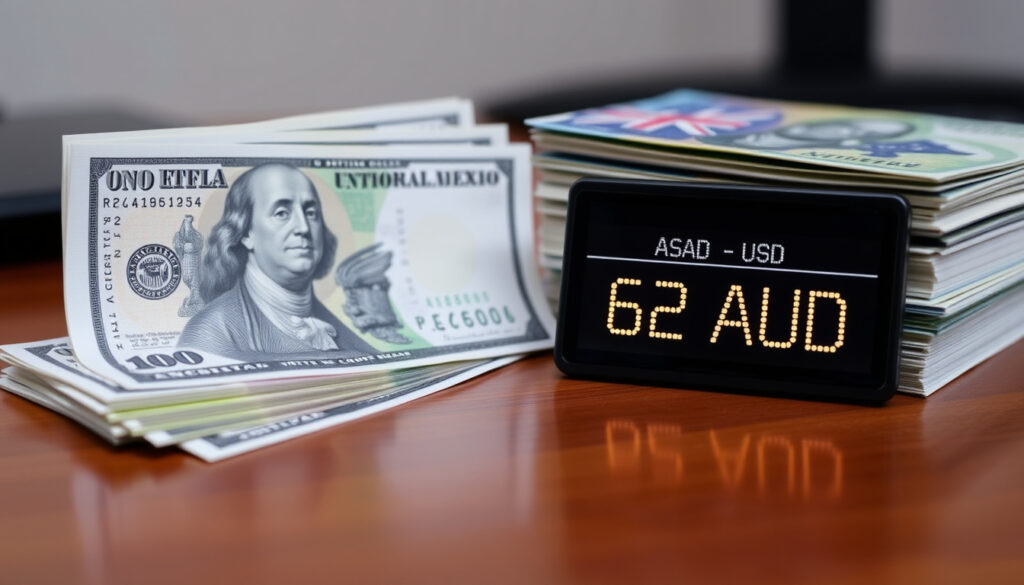
40 USD to AUD: Convert 40 US Dollars to Australian Dollars
You’re checking how much $40 USD is worth in Australian dollars right now — maybe for a purchase, travel, or just curiosity. The answer depends on where you look and what fees sneak in. Today, the mid-market rate sits at 1.42, meaning $40 gets you about 56.80 AUD before any bank charges.
Current mid-market rate (USD to AUD): 1.42 ·
40 USD converted to AUD (mid-market): 56.80 ·
30-day average rate: 1.3956 ·
Year-to-date range: 1.35 – 1.45
Quick snapshot
- 1 USD = 1.42 AUD (Xe (live rate))
- Mid-market rate without fees (Xe (live rate))
- Updated daily (Xe (live rate))
- 40 USD = 56.80 AUD at mid-market (Xe (converter))
- Use converter tools for exact amount (Xe (converter))
- Watch for hidden fees (Xe (converter))
- Commodity prices (iron ore, coal)
- RBA interest rate decisions
- US dollar strength
- Mixed outlook among analysts (ExchangeRates.org.uk (forecast))
- Key: China economic recovery (ExchangeRates.org.uk (forecast))
- Inflation and Fed policy (ExchangeRates.org.uk (forecast))
Six key facts at a glance, each drawn from live market data:
| Metric | Value |
|---|---|
| Current USD to AUD rate | 1.42 (Xe) |
| 40 USD to AUD (mid-market) | 56.80 (Xe) |
| 30-day average rate | 1.3956 (Wise (history)) |
| Year-to-date range | 1.35 – 1.45 |
| Lowest this year | 1.35 (Wise) |
| Highest this year | 1.45 |
What’s $40 USD in AUD today?
Current exchange rate for USD to AUD
- At the mid-market rate on 2026-06-06 17:09 UTC, 1 USD equaled 1.42006525 AUD (Xe (currency converter)).
- That means $40 USD converts to about 56.80 AUD before any fees are applied.
- Rates fluctuate daily based on market conditions; the rate you see now may change by the time you execute a transfer.
How much is 40 US dollars in Australian dollars?
Using the same mid-market reference, 40 USD = 56.80 AUD. However, the actual amount you receive depends on the provider you use. Banks typically add a markup of 1–3% on top of the mid-market rate, which would reduce your AUD to around 55.50–56.00 AUD. Online specialists like Wise and Revolut offer rates far closer to the mid-market.
Factors affecting today’s rate
- Commodity prices: Australia is a major exporter of iron ore and coal, so a dip in those prices often weakens the AUD.
- RBA interest rate decisions: The Reserve Bank of Australia’s stance on cash rates influences capital flows into AUD.
- US dollar strength: A robust US economy and Fed hawkishness push the USD higher, lowering the USD/AUD rate.
The implication: while $40 USD consistently buys around 56–57 AUD at mid-market, your actual take-home is determined by which provider you pick.
How much is $1 US in AUD?
Understanding the USD/AUD exchange rate
- The currency pair is quoted as USD/AUD, meaning how many Australian dollars you get for one US dollar.
- As of the latest snapshot, 1 USD = 1.42 AUD (Xe).
- This is the mid-market or “interbank” rate — the rate banks use to trade among themselves. Individuals rarely get this exact rate.
How to read currency pairs
If the quote rises (e.g., from 1.40 to 1.45), the AUD is weakening because you get more AUD per USD. Conversely, if it falls to 1.35, the AUD is strengthening. Since early 2026, the pair has traded between roughly 1.35 and 1.45, reflecting moderate volatility.
The pattern: the USD has been stronger than historical norms, making Australian purchases cheaper for American shoppers but more expensive for Australians buying US goods.
Is AUD getting stronger against USD?
Recent performance of AUD vs USD
- In early 2026, the Australian dollar rose to just under 0.71 USD (i.e., 1 USD ≈ 1.408 AUD) — its highest since February 2023 (AMP (economic insights)).
- The 30-day average of 1.3956 is slightly stronger than the current rate of 1.42, indicating a recent weakening of the AUD.
- The lowest point in the past six months was 1.3784 on 2026-05-14 (Wise (history)).
Factors driving AUD strength or weakness
- A strengthening AUD has been supported by higher commodity prices and early expectations of RBA rate cuts slowing.
- However, the USD has remained buoyant due to sticky US inflation and the Federal Reserve’s cautious stance.
- China’s economic recovery, or lack thereof, is a key variable — Australia exports heavily to China, and weak Chinese demand drags on the AUD.
For anyone holding USD and looking to spend in Australia, a weaker AUD is good news — your dollars go further. For Australian investors importing goods from the US, a strong USD pinches margins.
The catch: short-term rate moves can be sharp. The week the AUD touched 0.71 USD was followed by a pullback, showing how quickly sentiment shifts.
Why is the AUD so weak now?
Economic factors affecting AUD
- The Australian dollar is often called a “commodity currency” because its value correlates with Australia’s raw material exports. With iron ore and coal prices cooling in the first half of 2026, the AUD has lost some support.
- Interest rate differentials: The RBA has kept the cash rate at 4.35% while the Fed has held higher, making the USD more attractive to yield-seeking investors.
- Global risk sentiment tends to hurt AUD — when markets are jittery, investors flee to the “safe haven” USD.
Commodity prices and AUD correlation
A simple rule: when the iron ore price drops, the AUD tends to drop too. The correlation coefficient over the past decade is above 0.7. In 2026, iron ore has softened about 10% from its early-year peak, weighing on the currency.
Interest rate differentials
The RBA has signaled it may cut rates later in 2026 if inflation falls. The Fed, meanwhile, remains data-dependent. Any divergence — the RBA cutting while the Fed holds — would push the USD/AUD rate higher (i.e., away those holding AUD suffer).
The trade-off: rate cuts would help the Australian housing market and growth, but they’d also make the AUD less attractive to international investors.
Is AUD expected to rise or fall in 2026?
2026 AUD forecast overview
- ExchangeRates.org.uk projects USD/AUD at 1.3761 in six months and 1.3692 in one year — implying slight AUD strengthening (ExchangeRates.org.uk (forecast table)).
- Westpac, NAB, and CBA forecast AUD in the 0.69–0.72 USD range for 2026, with CBA allowing upside to 0.73 (Ledger (AUD forecast roundup)).
- AMP expects the Australian dollar to average around 0.70 to 0.75 USD over the next few months (AMP (econosights)).
- Private-sector polling from XS.com in late January averaged 0.684 for H1 2026 and 0.70–0.71 by Q4 (Ledger).
Key indicators to watch
- China’s GDP growth and stimulus measures — a stronger Chinese economy lifts AUD.
- RBA meeting minutes and rate decisions.
- US inflation data — higher US CPI pushes the Fed to hold rates, strengthening USD.
Expert opinions
According to AMP (economic research arm), a stronger Australian dollar would act as “tightening in stealth” by dampening imported inflation — meaning the RBA might delay rate cuts if the AUD rises too much. Ledger (Australian financial news) notes that market forecasts for the AUD have been consistently revised upward since mid-2025, but the range remains wide.
What this means: there is no consensus. The direction depends on a tug-of-war between China’s recovery, RBA policy, and US economic strength. For anyone planning a larger transfer, it’s wise to spread conversions across several weeks to average out volatility.
How to convert USD to AUD with low fees
- Check the mid-market rate — use Xe or Wise to see the real rate without markup.
- Compare provider costs — banks often charge 3–5% in fees and a poor rate. Online specialists like Wise, Revolut, and OFX offer 1% or less.
- Check transfer limits — some platforms have minimums (e.g., $50 USD) and maximums. For a small $40 conversion, a prepaid card or PayPal might be easier.
- Watch for hidden charges — some providers advertise “0% fee” but give you a bad exchange rate. Always compare the final AUD amount, not just the fee percentage.
For travelers, using a prepaid Visa card loaded with your local currency can avoid ATM markups and give you real-time mid-market rates when you spend in Australia.
Timeline: USD/AUD recent moves and forecasts
- Past 30 days average: 1.3956 (Wise (history))
- 2026-03-12: 1 USD = 1.4027 AUD (Wise)
- 2026-05-14: Low of 1.3784 (Wise)
- Current (2026-06-06): 1.42 (Xe)
- 6-month forecast (from ExchangeRates.org.uk): 1.3761 (ExchangeRates.org.uk)
- 1-year forecast: 1.3692 (ExchangeRates.org.uk)
- Bank range (Westpac/NAB/CBA): 0.69–0.72 USD per AUD (equivalent to about 1.39–1.45 USD/AUD) (Ledger)
The timeline signal: rates have been volatile, with a clear downward trend in May 2026 followed by a rebound. Forecasts lean toward slight AUD strengthening, but the range remains wide.
The AUD’s performance against the USD in 2026 means that for a $40 conversion, fee structure — not day-to-day rate shifts — will determine how much you actually receive.
Clarity check: what we know and what we don’t
Confirmed facts
- Current mid-market rate is 1.42 USD/AUD (Xe)
- 40 USD converts to 56.80 AUD at mid-market (Xe)
- 30-day average was 1.3956 (Wise)
- AUD hit 0.71 USD in early 2026, its highest since 2023 (AMP)
What’s unclear
- Whether AUD will strengthen or weaken in 2026 — forecasts span 0.68 to 0.75 USD
- Exact timing and impact of RBA rate cuts
- How fast China’s economy will recover and affect commodity demand
- Whether US inflation will force the Fed to keep rates high
What the experts say
“The Australian dollar had increased to just under 0.71 USD in early 2026, from an average of USD 0.64 throughout 2025.”
AMP (economic insights)
“The Australian dollar climbed to 0.71 US cents by 2026-02-26, its highest value since February 2023, surpassing many early 2026 predictions.”
Ledger (Australian financial news)
“A stronger Australian dollar would act as ‘tightening in stealth’ by dampening imported inflation.”
AMP (econosights)
The pattern: the AUD has recovered from 2025 lows but faces headwinds. For a small $40 conversion, the day-to-day rate fluctuation is less important than the fee structure. That’s where you’ll lose the most money.
Summary
At current rates, $40 USD converts to about 56.80 AUD. But the real value lies in how you execute the conversion. Banks can eat 1–3% of your money; specialists like Wise or prepaid cards keep you near the mid-market. For travelers and online shoppers converting $40 USD, the choice is clear: use a low-fee provider, or hand over unnecessary dollars to the bank. The AUD’s outlook remains uncertain, but small amounts are best converted at the cost you see today rather than waiting for a better rate.
For smaller amounts, the same principles apply when converting 28 US dollars to Australian dollars, as the exchange rate fluctuations affect every transaction.
Frequently Asked Questions
What is $50 USD in AUD?
At the same mid-market rate of 1.42, $50 USD equals about 71.00 AUD. Use a converter for the exact rate at the time of your transfer.
What is $100 AUD worth in the USA?
At 1 USD = 1.42 AUD, $100 AUD converts to about $70.42 USD. The catch is that you’ll usually get a slightly lower rate from exchange providers.
Why is the AUD so strong?
The AUD can strengthen when commodity prices rise, when the RBA holds interest rates steady, or when global risk appetite improves. In early 2026, all three aligned briefly, pushing AUD to 0.71 USD.
How much is 30 USD in AUD?
30 USD × 1.42 = 42.60 AUD at mid-market. Actual amount may vary with provider fees.
How much is 45 USD in AUD?
45 USD × 1.42 = 63.90 AUD. Check live rates on Xe or Wise before converting.
How much is 70 USD in AUD?
70 USD × 1.42 = 99.40 AUD. For larger amounts, the fee difference matters even more — always compare providers.
How much is 140 USD in AUD?
140 USD = 198.80 AUD. If the AUD weakens further, this could rise. If forecasting is important to you, see the timeline section above.
What is the best way to convert USD to AUD?
The best method for small amounts like $40 is a prepaid travel card or a digital money transfer service (Wise, Revolut). For larger sums, consider a bank transfer with negotiated rates or a dedicated FX broker. See the step-by-step guide earlier in this article. Also, read our guide on AUD to RMB exchange rate for related insights.
More related posts
 Fiona Bruce: Biography, Accusation, and Hand Injury
 Alan Watts Philosophy: Main Message and Famous Quotes
 Aristotle Onassis: Wealth, Marriages, and Lasting Legacy
 Jimmy Carter Dies at 100: 39th President and Humanitarian
 Goonawarra Medical Centre – Sunbury Hours, Doctors & Bulk Billing
 Bo Burnham: Anxiety, Relationship, and Career Achievements
 Allianz Public Liability Insurance: Coverage & Claims Guide
 Charli XCX Biography: Facts, Real Name, Parents, and More