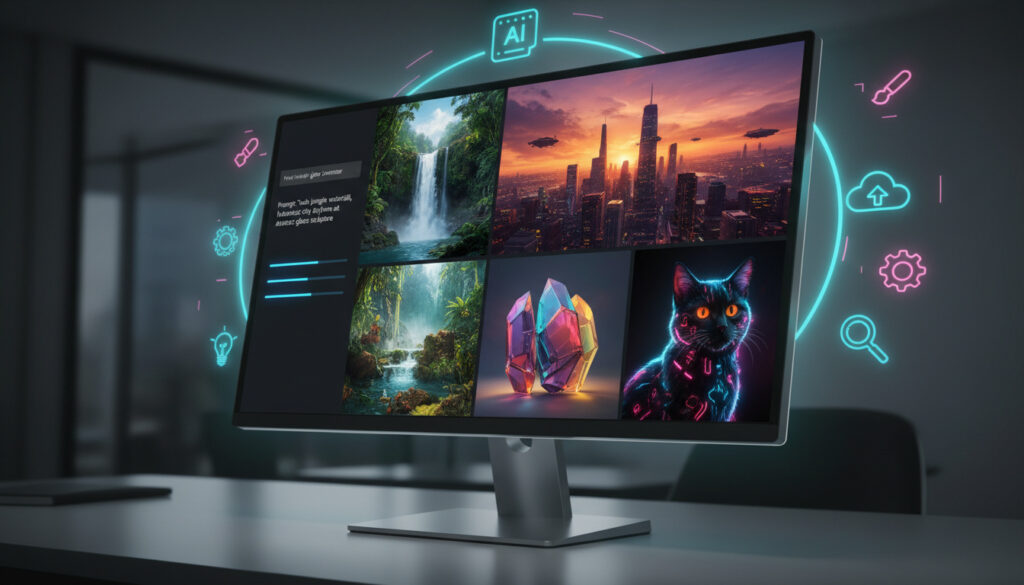
AI Image Generator Free – Top Tools for Quality Images
The Democratization of Digital Artistry
The proliferation of generative artificial intelligence has removed traditional barriers to digital content creation. Free AI image generators now provide marine researchers, educators, and conservationists with sophisticated tools for visualizing reef ecosystems, creating educational materials, and prototyping coral reef monitoring visualizations without proprietary software costs. These platforms transform text descriptions into high-fidelity imagery through latent diffusion models and transformer architectures.
Accessible Generative Tools
Midjourney
Midjourney offers a limited trial period allowing users to generate photorealistic underwater scenes and artistic reef interpretations. The platform excels at aesthetic composition, though free access requires joining their Discord server initially.
DALL-E 3
DALL-E 3, accessible through Microsoft’s Bing Image Creator, provides robust text-to-image capabilities with improved prompt adherence compared to previous iterations. Users receive weekly enhanced generation credits, making it suitable for creating scientific diagrams and educational illustrations.
Stable Diffusion
Stability AI distributes Stable Diffusion as open-source software, enabling unlimited local generation on compatible hardware. This option appeals to organizations requiring data privacy for sensitive research imagery.
Leonardo AI
Leonardo AI targets creative professionals with a daily token system for free users, offering specialized models for texture generation and concept art relevant to marine biodiversity documentation.
Bing Image Creator
Bing Image Creator integrates DALL-E 3 directly into Microsoft’s search ecosystem, providing a streamlined interface for rapid prototyping of conservation campaign visuals without account registration barriers.
Playground AI
Playground AI offers a free tier with mixed model access, including Stable Diffusion checkpoints and proprietary filters, facilitating experimental approaches to underwater photography enhancement and habitat visualization.
Market Dynamics
The competitive landscape shifted significantly when major technology corporations began subsidizing consumer access to diffusion models. This strategy prioritizes market share acquisition over immediate revenue, resulting in professional-grade tools available at no cost. Concurrently, open-source communities have optimized model weights for consumer-grade GPUs, reducing the computational threshold for high-resolution generation.
Comparative Analysis
| Platform | Free Allocation | Maximum Resolution | Licensing Terms | Ideal Use Case |
|---|---|---|---|---|
| Midjourney | Limited trial (approx. 25 jobs) | 1024×1024 | CC BY-NC 4.0 for free tier | Artistic reef interpretations |
| DALL-E 3 | 15 boosted credits weekly | 1024×1024 | Full usage rights | Educational diagrams |
| Stable Diffusion | Unlimited local | Configurable up to 2048×2048 | Open source (CreativeML Open RAIL-M) | Private research visualization |
| Leonardo AI | 150 tokens daily | 1024×1024 | Commercial use permitted | Texture generation |
| Bing Image Creator | 100 boosts (slow generation after) | 1024×1024 | Personal use prioritized | Rapid campaign prototyping |
| Playground AI | 500 images daily | 1024×1024 (2K with Pro) | Commercial use allowed | Mixed model experimentation |
Technical Capabilities
Modern free generators utilize latent diffusion models trained on billions of image-text pairs. These systems encode visual information into compressed latent spaces, progressively denoising random data into coherent images through U-Net architectures. Advanced platforms incorporate inpainting, outpainting, and ControlNet features allowing precise composition control for scientific accuracy in marine illustrations.
Evolution of Accessibility
-
Midjourney launches public beta, introducing subscription-free access to high-quality generation for Discord users.
-
Stability AI releases Stable Diffusion weights publicly, democratizing local inference capabilities and reducing reliance on cloud APIs.
-
OpenAI integrates DALL-E 3 with ChatGPT, expanding free access through Microsoft’s partnership and enhanced safety filtering.
-
Bing Image Creator enhances free tier with DALL-E 3 integration, increasing daily generation limits for Microsoft account holders.
-
Leonardo AI expands free token allocation for registered conservation organizations and educational institutions.
Legal and Practical Considerations
The term “free” encompasses various economic models. Some platforms retain broad licensing rights to generated content unless users subscribe, while others permit unrestricted commercial use. Copyright ownership of AI-generated imagery remains legally ambiguous in many jurisdictions, particularly regarding training data licensing. Organizations utilizing these tools for marine education publications should verify specific platform terms regarding derivative works and attribution requirements.
Conservation Applications
These technologies enable rapid prototyping of visualization materials for fundraising campaigns and scientific communication. Small non-profits can now produce publication-quality imagery depicting hypothetical reef restoration outcomes or extinct marine species reconstructions without commissioning expensive digital artists. However, reliance on AI-generated training data raises concerns about biological accuracy, necessitating expert review when depicting specific taxonomic details for scientific contexts.
Expert Perspectives
The accessibility of diffusion models has fundamentally altered how we approach public outreach. We can now visualize climate change impacts on reef structures that cameras cannot easily capture.
Dr. Elena Martinez, Marine Visualization Researcher
While free tiers offer remarkable capabilities, conservation organizations must evaluate the carbon footprint of cloud-based generation against local processing alternatives.
James Chen, Computational Sustainability Advocate
Conclusion
Free AI image generators have established permanent infrastructure within the digital conservation toolkit. While limitations exist regarding commercial licensing and biological precision, these platforms provide unprecedented access to visual communication technologies. As models continue to optimize for efficiency and accuracy, their integration with field monitoring applications and educational outreach will likely deepen, provided ethical guidelines govern their deployment.
Frequently Asked Questions
Can AI-generated reef images be used in scientific publications?
Usage depends on the specific platform’s terms of service. Most free tiers grant personal use rights, but commercial or academic publication may require paid licenses. Always verify current terms before submitting AI-generated content to peer-reviewed journals.
Do free AI image generators require attribution?
Attribution requirements vary by platform. Open-source models like Stable Diffusion typically require adherence to the CreativeML Open RAIL-M license, while proprietary services like DALL-E 3 do not mandate attribution for generated images, though citing the tool remains ethical best practice.
What hardware is needed for local generation?
Running Stable Diffusion locally requires a GPU with at least 4GB VRAM, though 8GB is recommended for higher resolutions. Cloud-based alternatives eliminate hardware requirements but require stable internet connections.
Are generated images copyrightable?
The U.S. Copyright Office currently requires human authorship for registration. AI-generated images without substantial human modification generally cannot be copyrighted, though this legal landscape continues evolving across jurisdictions.
How do free tiers handle data privacy?
Most cloud-based generators retain the right to store and potentially review prompts and generated images for model improvement. Organizations handling sensitive ecological data should utilize local installation options like Stable Diffusion to maintain confidentiality.
Can these tools accurately depict specific coral species?
While modern generators recognize common species like Acropora or Porites, biological accuracy varies. AI models may hallucinate anatomical details or colorations. All scientific depictions require verification by marine biologists before publication or educational use.
More related posts
 Weetbix Slice Recipe – Easy No-Bake Guide
 Costeen Hatzi: Age, Career, and Split from Nick Kyrgios
 Pakistan vs England: Out of T20 World Cup 2026 Semifinals
 Gen Alpha: Birth Years, Key Traits, and Facts
 Amanda Holden: Biography, Family, Feuds, and Net Worth
 Vince Zampella: Cause of Death, Crash, and Net Worth
 Rubbish Removal Sydney – Prices, Providers and Booking Guide
 Ashes 5th Test – England Win by 49 Runs at The Oval