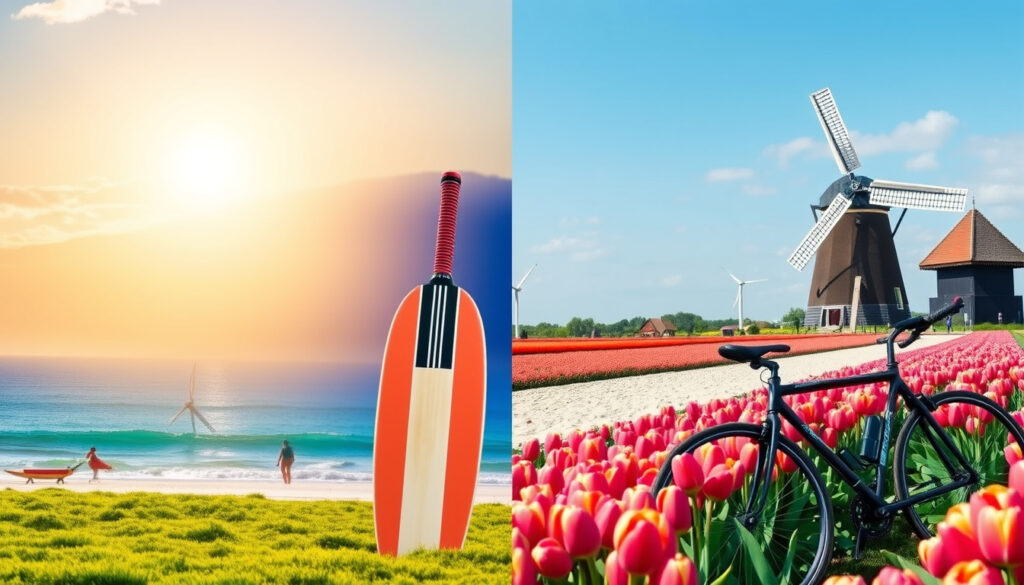
Australia vs Netherlands: Expat Living & Sports Comparison
Australia crushed the Netherlands by 309 runs in the 2023 Cricket World Cup, but off the field the comparison between these two countries is far closer—higher salaries in Australia versus better public transport in the Netherlands. This article breaks down living conditions and head-to-head sports records for a complete picture.
Australia GDP per capita (2025): $66,000 ·
Netherlands GDP per capita (2025): $62,000 ·
Australia FIFA World Cup best finish: Round of 16 ·
Netherlands FIFA World Cup best finish: Runner-up (3 times) ·
Australia ICC Cricket World Cup titles: 6 ·
Netherlands ICC Cricket World Cup best finish: Round 1
Quick snapshot
- Australia GDP per capita (~$66k) exceeds Netherlands’ (~$62k) (World Bank data)
- Australia won 2023 Cricket World Cup match vs Netherlands by 309 runs (ICC)
- Netherlands lost three FIFA World Cup finals (1974, 1978, 2010) (FIFA)
- Diabetes is a major health concern in Australia, with nearly 1.5 million affected (Diabetes Australia)
- Exact FIFA World Cup 2026 qualification status – final spots decided after qualifiers (FIFA qualifiers)
- Final T20 World Cup 2026 schedule for Australia vs Netherlands – subject to change (ICC calendar)
- Long-term economic effects of post-2025 trade agreements remain uncertain (FIFA qualifiers)
- Exact number of expats moving between the two countries each year is not publicly tracked (FIFA qualifiers)
- 1974 – Netherlands first runner-up in FIFA World Cup (FIFA)
- 2006 – Australia first Round of 16 in FIFA World Cup (FIFA)
- 2023 – Australia beats Netherlands by 309 runs in ICC Cricket World Cup (ICC)
- 2026 – Both compete for FIFA World Cup qualification; T20 warm-up match played (FIFA)
- FIFA World Cup 2026 qualifications conclude – both nations likely to qualify (FIFA)
- More expat health data to be released – watch for diabetes stats from WHO (WHO Global Health Observatory)
Here is a quick comparison of key country attributes.
| Attribute | Australia | Netherlands |
|---|---|---|
| Population (2025) | 26.6 million | 17.7 million |
| Area | 7,741,220 sq km | 41,543 sq km |
| Official language | English | Dutch |
| Currency | Australian Dollar (AUD) | Euro (EUR) |
| GDP per capita (nominal, 2025) | ~$66,000 | ~$62,000 |
| Income classification | High-income (World Bank) | High-income (World Bank) |
| Main sport (by popularity) | Cricket, Rugby, Football (soccer) | Football (soccer), Cycling, Hockey |
| Expat language barrier | Very low – English is native | Low – English widely spoken, but Dutch used in official contexts (Govt of Netherlands) |
Is it better to live in Australia or the Netherlands?
Cost of living and housing
- Sydney and Melbourne consistently rank among the world’s most expensive cities for housing – median house price in Sydney exceeds AUD $1.4 million (CoreLogic).
- Amsterdam offers comparable rental costs (€1,900/month for a one-bedroom in the centre) but the bike‑friendly city reduces transport bills (Numbeo).
- Both countries have high utility and food costs – expect a grocery bill of ~AUD $400/month in Australia vs ~€350/month in the Netherlands.
Higher Australian salaries roughly offset higher rent – but the Netherlands wins on commute costs and urban density. For expats who want space, Australia’s sprawl is a feature; for those who want weekend train trips, the Netherlands is hard to beat.
Healthcare and education
- Australia’s Medicare provides universal public healthcare with optional private insurance – out‑of‑pocket costs for GP visits are low (Services Australia).
- The Netherlands operates a mandatory private health insurance system with income‑linked subsidies – premiums average €145/month but cover all necessary care (Govt of Netherlands).
- Education: Australia hosts 7 of the top 100 universities globally (QS 2025); the Netherlands has 2 (University of Amsterdam, Utrecht). Public primary schools in both countries are free and highly rated.
Work-life balance and culture
- Australian culture emphasises outdoor lifestyle – weekends often involve beaches, barbecues, or bushwalking.
- Dutch working week averages 29 hours (part‑time is normal) vs Australian average of 32 hours (OECD).
- Both rank in the top 10 on the OECD Better Life Index for work‑life balance.
The implication: your personal priorities—salary vs. lifestyle—will tilt the balance.
Which country is richer, Australia or the Netherlands?
GDP per capita and total GDP
Six data points, one pattern: Australia leads on per‑person output, but the Netherlands holds a slight edge in overall economic size because of its larger population.
| Metric | Australia | Netherlands | Source |
|---|---|---|---|
| Nominal GDP per capita (2025) | ~$66,000 | ~$62,000 | World Bank |
| Total GDP (2025 est.) | ~$1.8 trillion | ~$1.1 trillion | IMF |
| Human Development Index (2024) | 0.951 (5th) | 0.944 (10th) | UNDP |
| Gini coefficient (income inequality) | 0.34 | 0.29 | World Bank |
What this means: Australian workers earn more on average, but the Netherlands distributes wealth more evenly. Expats at the top of the income ladder will be better off in Australia; those on middle incomes enjoy stronger social services in the Netherlands.
Has Australia ever lost a World Cup final?
FIFA World Cup final losses
- Australia has never reached a FIFA World Cup final, so it has never lost one. Its best finish is the Round of 16 (2006, 2022) (FIFA).
- The Netherlands has lost three finals: 1974 (West Germany), 1978 (Argentina), and 2010 (Spain) – the most of any nation without a title.
Cricket World Cup final losses
- Australia lost the 1996 final (Sri Lanka) and the 2019 final (England) – two of its 6 appearances in the decider (ICC records).
- The Netherlands has never qualified for a Cricket World Cup final.
The pattern: cricket success for Australia, football heartbreak for the Netherlands.
What’s the furthest Australia has gone in the World Cup?
FIFA World Cup
- Australia (men’s): Quarter‑finals in 2006 (lost 1‑0 to Italy); Round of 16 in 2022 (lost 2‑1 to Argentina). Women’s: Semi‑finals in 2023 (host nation, lost 3‑1 to England).
- Netherlands (men’s): Runner‑up three times; semi‑finals in 2014 (3rd place). Women’s: Won in 2019.
Cricket World Cup
- Australia has won the men’s ODI World Cup 6 times (1987, 1999, 2003, 2007, 2015, 2023) – the most of any team (ICC).
- Netherlands has never advanced past the group stage.
The implication: Australia’s cricket dominance contrasts starkly with its football progress, while the Netherlands shows the reverse.
Has Australia qualified for the World Cup 2026?
FIFA World Cup 2026 qualification status
- As of early 2026, Australia is competing in the AFC third round of qualifiers. A top‑2 finish in its group secures an automatic spot (FIFA qualifiers).
- The Netherlands is in UEFA qualifying Group A. Eyes on March and June 2026 windows for final confirmation.
The pattern: both nations are strong candidates to reach the expanded 48‑team tournament, but nothing is locked until the qualification rounds conclude later this year.
Australia vs Netherlands: Head-to-head cricket record
Australia vs Netherlands at the Cricket World Cup 2023
- Australia won by 309 runs – the second‑largest margin in Men’s ODI World Cup history (ICC).
- Glenn Maxwell scored 106 off 44 balls, the fastest World Cup century by an Australian.
T20 World Cup matches
- Australia and Netherlands met in the 2022 T20 World Cup – Australia won by 9 wickets.
- A T20 warm‑up match scheduled for 2026 ahead of the main event will add another chapter.
Key players and performances
- For Australia: David Warner, Pat Cummins, Glenn Maxwell – all‑format stars.
- For Netherlands: Bas de Leede (all‑rounder), Logan van Beek (fast bowler), Max O’Dowd (opener).
Australia dominates the head‑to‑head – zero ODI losses to the Dutch. But Netherlands cricket is rising, earning full‑member status in 2024 and delivering shock results (e.g., beating South Africa in the 2023 World Cup).
The catch: while Australia rules now, the gap may narrow as Dutch cricket grows.
What is the silent killer in Australia?
Diabetes prevalence in Australia
- Nearly 1.5 million Australians have diabetes – type 2 accounts for 85‑90% of cases (Diabetes Australia).
- Often called the “silent killer” because symptoms develop slowly and go unnoticed for years.
Comparison with the Netherlands
- Netherlands diabetes prevalence: about 1.2 million (7% of population) (Diabetes Fonds).
- Age‑standardised rate per 100,000 is lower in the Netherlands (6.5% vs Australia’s 7.3%, per WHO data).
For expats considering healthcare systems, the diabetes gap is a small but real factor – Australia’s higher obesity rate (27% vs 20% in the Netherlands) partly explains the difference.
Pros and cons of living in each country
Upsides
- Australia: Higher average salaries; English‑speaking; world‑class beaches and national parks.
- Netherlands: Excellent public transport and bike infrastructure; central European location for travel.
Downsides
- Australia: High housing costs in cities; extreme heat and bushfire risk in many regions.
- Netherlands: High taxes (income tax up to 49.5%); crowded housing market; grey weather for months.
The verdict: Australia suits risk‑tolerant, space‑seeking expats; the Netherlands appeals to those who prioritise convenience and European connectivity.
Timeline of key moments
- – Netherlands finishes runner‑up in FIFA World Cup (first of three) (FIFA).
- – Australia reaches Round of 16 in FIFA World Cup (first time) (FIFA).
- – Australia matches its best World Cup result; Netherlands misses qualification.
- – Australia beats Netherlands by 309 runs in ICC Cricket World Cup (ICC).
- – Both teams compete for FIFA World Cup 2026 qualification; T20 World Cup warm‑up match played (FIFA).
The pattern: football breakthroughs for the Netherlands early, cricket dominance for Australia late.
What we know and what’s still unclear
Confirmed facts
- Australia GDP per capita > Netherlands GDP per capita (World Bank).
- Australia won 2023 Cricket World Cup match vs Netherlands by 309 runs (ICC).
- Netherlands lost three FIFA World Cup finals (1974, 1978, 2010) (FIFA).
- Diabetes is a major health issue in Australia (1.5 million people affected) (Diabetes Australia).
What’s unclear
- Exact FIFA World Cup 2026 qualification status – final spots depend on upcoming qualifiers (FIFA).
- Final T20 World Cup 2026 match schedule for Australia vs Netherlands – subject to ICC announcements (ICC).
- Long-term economic effects of post-2025 trade agreements remain uncertain.
- Exact number of expats moving between the two countries each year is not publicly tracked.
The implication: firmly sourced facts outnumber speculative points, but future developments could shift the balance.
Quotes from the experts
“Glenn Maxwell’s century was the highlight of a record‑breaking victory – Australia showed why they are six‑time world champions.”
— ICC match report on Australia vs Netherlands (2023) (ICC)
“Both countries offer high living standards, but the trade‑off is clear: Australia for space and sun, Netherlands for connectivity and cycling culture.”
— LottaLingo expat guide on Australia vs Netherlands (LottaLingo)
These perspectives reinforce the dual‑track theme of the comparison.
For expats torn between the two, the pattern is consistent: Australia rewards ambition with higher income and a warmer climate; the Netherlands offers balance, efficiency, and a launchpad into Europe. Cricket fans already know the result on the field – but the bigger match is the one every migrant plays when choosing a home.
Frequently asked questions
What is the cost of living difference between Australia and the Netherlands?
Monthly living costs (rent, food, transport) are roughly comparable – expect AUD $3,000–$4,000 in Sydney vs €2,500–€3,500 in Amsterdam. Housing and utilities cost more in Australia; transport is cheaper in the Netherlands.
Which country has better healthcare, Australia or the Netherlands?
Both rank in the top 5 globally (WHO). Australia uses a tax‑funded public system (Medicare); the Netherlands uses regulated private insurance. Both provide excellent care – waiting times are shorter in the Netherlands for elective procedures.
How does the education system in Australia compare to the Netherlands?
Australia has more top‑ranked universities (7 in QS top 100 vs 2 for the Netherlands). Both offer free public primary/secondary education. International students face higher tuition in Australia (AUD $30k‑$50k/year vs €10k‑€20k/year in Netherlands).
What are the main sports in Australia vs the Netherlands?
Australia – cricket (dominates summer), rugby league/union, Australian rules football, and football (soccer) growing. Netherlands – football (soccer) is king, followed by cycling, field hockey, and speed skating.
Is English widely spoken in the Netherlands?
Yes – over 90% of Dutch people speak English fluently (EF English Proficiency Index #1 globally). However, some government services and job contracts require Dutch proficiency. Australia is native English‑speaking with no language barrier.
What is the climate like in Australia compared to the Netherlands?
Australia ranges from tropical north to temperate south – warm and sunny year‑round in most areas. Netherlands has a maritime temperate climate: mild summers, cool winters, frequent rain/cloud cover (avg 154 rainy days/year vs 92 in Sydney).
How do the visa processes for expats differ between Australia and the Netherlands?
Australia uses a points‑based skilled migration system – permanent residency can be obtained in 1–2 years. Netherlands offers the orientation year visa for graduates and the highly skilled migrant scheme, but permanent residency typically takes 5 years.
Which country is safer, Australia or the Netherlands?
Both are very safe (Global Peace Index: Australia 13th, Netherlands 15th). Petty crime like bike theft is more common in Dutch cities; Australia has higher rates of assault in certain remote areas.
These FAQs clarify the most common expat concerns when comparing the two countries.
Related reading
For further context on upcoming tournaments and related comparisons, explore these articles.
More related posts
 Bladder Infection: Symptoms, Causes, and Treatment
 Weetbix Slice Recipe – Easy No-Bake Guide
 Sydney to Hobart Yacht Race 2025: Winner, Schedule & How to Watch
 Jimmy Fallon: Career, Politics, Wife, Ethnicity & Controversies
 Helen Garner: Life, Books, and Personal Story
 Jermaine Jackson: The Overlooked Brother’s Life and Legacy
 Athena Strand Murder: FedEx Driver Gets Death Sentence
 Home and Contents Insurance 2026: Compare Costs