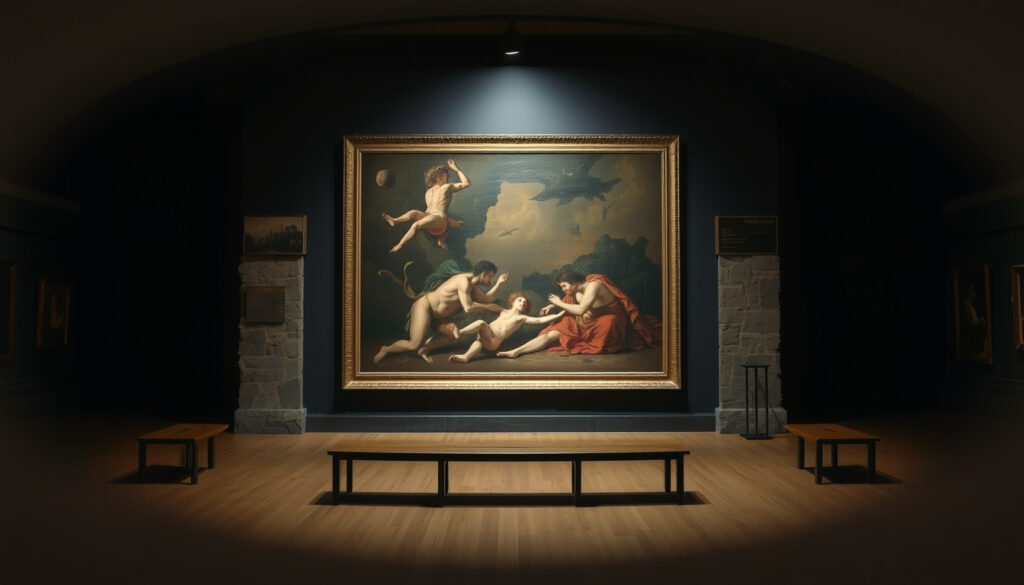
Goya’s Saturn Devouring His Son: Meaning, Location, Worth
There are paintings that haunt you quietly, and then there’s Goya’s Saturn Devouring His Son—a work that practically screams across the centuries. Completed between 1820 and 1823 (Museo Nacional del Prado, the Spanish national museum), this terrifying image of a god consuming his own child remains one of the most disturbing masterpieces in Western art. What makes it so powerful isn’t just the cannibalism, but the dark convergence of personal despair, political fury, and ancient myth. Here’s what the records actually show about its meaning, location, and value.
Year painted: 1820–1823 ·
Medium: Oil mural transferred to canvas ·
Dimensions: 143 cm × 81 cm ·
Location: Museo del Prado, Madrid ·
Series: Black Paintings ·
Estimated value: $10 million+ (insured)
Quick snapshot
- The painting was created by Francisco Goya (Museo Nacional del Prado)
- It belongs to the Black Paintings series (Museo Nacional del Prado)
- It is currently housed at the Museo del Prado (Museo Nacional del Prado)
- The exact year of completion within 1820–1823 is uncertain
- Goya did not leave a written explanation of the painting’s meaning
- Goya’s precise mental health diagnosis is unknown
- 1819: Goya purchases Quinta del Sordo (Museo Nacional del Prado)
- 1820–1823: The Black Paintings are created directly on the walls (Museo Nacional del Prado)
- 1874: Murals transferred to canvas (Artnet, contemporary art journalism)
- 1881: Moved to the Museo del Prado (Museo Nacional del Prado)
- Ongoing scholarly re-examination of the Black Paintings (Museo Nacional del Prado)
- Continued display in Room 67 of the Prado (Museo Nacional del Prado)
Nine official data points anchor the painting’s identity in the historical record.
| Field | Value |
|---|---|
| Full title | Saturn Devouring His Son |
| Artist | Francisco Goya |
| Period | Romanticism |
| Creation date | 1820–1823 |
| Medium | Oil on canvas (originally wall mural) |
| Dimensions | 143 cm × 81 cm |
| Current location | Museo del Prado, Madrid |
| Series | Black Paintings |
| Insurance value | Estimated $10–15 million |
How much is Saturn eating his son worth?
How was the painting valued?
Never sold on open market: True ·
Insurance valuation: $10–15 million ·
Appraisal status: None (national heritage)
The painting has never been traded or auctioned because it has belonged to the Museo del Prado since 1881, when the Black Paintings were donated to the Spanish state. As national heritage, no formal appraisal exists for the open market. Insurance valuations are speculative, with figures ranging between $10 and $15 million routinely cited (Artnet, contemporary art journalism).
Has it ever been sold?
- The work was acquired by the Spanish state as part of a donation and has never been resold (Museo Nacional del Prado).
- If it were to leave the museum (extremely unlikely under Spanish heritage law), experts estimate a price in the tens of millions.
For collectors and investors, the painting is effectively priceless—a masterpiece locked in a public collection, its cultural value far exceeding any hypothetical market price.
The trade-off: The painting’s security in the Prado ensures universal access, but means its monetary worth will always be a matter of speculation rather than transaction.
Where is the Saturn eating his son painting?
Original location in Goya’s villa
- Painted on the plaster wall of Goya’s dining room in Quinta del Sordo (Villa of the Deaf Man) (Museo Nacional del Prado).
- The house was purchased by Goya in 1819 outside Madrid (Museo Nacional del Prado).
- It originally hung opposite a portrait of his companion Leocadia Zorrilla (Museo Nacional del Prado).
Current location at Museo del Prado
From private dining room wall to national museum gallery, the painting’s physical path mirrors its shift from personal expression to public cultural icon.
- In the 1870s, the new owner of the villa decided to transfer the murals to canvas—a process that damaged several works (Artnet, contemporary art journalism).
- In 1881, the canvases were donated to the Spanish state and installed at the Museo del Prado in Madrid (Museo Nacional del Prado).
- Today, Saturn Devouring His Son is displayed in Room 67 alongside the rest of the Black Paintings series (Museo Nacional del Prado).
Why this matters: The journey from private home to public museum fundamentally changed the painting’s context. What was a domestic, intimate confrontation with mortality became a public spectacle viewed by millions.
What does Goya’s Saturn symbolize?
The myth of Saturn (Cronus)
- In Greek mythology, Cronus (Romanized as Saturn) was told by his parents that he would be overthrown by one of his own children (Britannica, established reference work).
- To prevent this, he devoured each child immediately after birth.
- Britannica, established reference work notes that Goya’s version is much darker than traditional mythic depictions—not a formal god, but a wild, mad-eyed figure tearing a future god apart.
Political allegory in Goya’s time
Artnet, contemporary art journalism notes that many historians link the image directly to Spain’s war with France and Goya’s despondency over the politics of his era.
The Museo del Prado itself suggests the god may personify the fear of losing power—a direct reflection of the absolutist regime’s brutality (Museo Nacional del Prado).
The implication: The painting layers personal, mythological, and political terror into a single, unforgettable image. It rejects a single reading, which is precisely what gives it enduring power.
What is the message of Saturn devouring his son?
Art historical interpretations
- Art critic Robert Hughes described it as “a vision of absolute terror”—a meditation on human cruelty and the futility of power.
- Janis Tomlinson, a Goya biographer, interprets the painting as a critique of political oppression, framed within the artist’s despair over the Spanish Inquisition and the Peninsular War.
- Wikipedia, crowdsourced encyclopedia summarizes a wide range of readings: the conflict between youth and old age, time as the devourer of all things, and an allegory of Spain’s civil violence.
Psychological readings
- The grotesque imagery may reflect Goya’s own mental state and fear of mortality.
- Britannica, established reference work links the wide-eyed stare of Saturn to madness and paranoia.
The catch: The very ambiguity that makes the painting so compelling is the source of endless debate. Without Goya’s own written commentary, every interpretation remains a best-informed guess.
What was Goya’s mental illness?
Goya’s later years and illness
Goya’s encounter with death and illness directly shaped the Black Paintings. In 1792–93, an unknown illness struck him down, leaving him permanently deaf. The isolation that followed is often cited as a catalyst for his darkest works.
While the exact diagnosis remains unknown—speculation includes lead poisoning from his paints, depression, or paranoia—the effect on his art is undeniable. Goya is thought to have retreated to the Quinta del Sordo where he painted the Black Paintings directly onto his walls, as documented by the Prado (Museo Nacional del Prado).
Impact on his art
- His illness influenced the dark, introspective nature of the Black Paintings.
- Unlike his earlier court portraits and the bright, optimistic prints of the Caprichos, the Black Paintings display a raw, deeply personal edge.
The pattern: The connection between genius and madness is a persistent narrative in art history, but in Goya’s case the evidence is circumstantial. What is certain is that his physical and psychological state entered a steep decline just as his work reached its most potent.
What is Goya’s most disturbing painting?
Other disturbing works by Goya
- Witches’ Sabbath (a coven of grotesque creatures)
- Judith and Holofernes (a biblical beheading)
- Pilgrimage to the Fountain of San Isidro (a chaotic, drunken crowd)
Goya’s later works are filled with violence and despair, but none match the raw, almost primal fear inspired by Saturn. Artnet, contemporary art journalism describes the painting as “one of the darkest and most disturbing works in Western art.”
Why Saturn stands out
- The subject matter—cannibalism—immediately breaks a profound human taboo.
- The raw emotion of the figures, painted with a restricted palette of black, ochre, and red, creates an atmosphere of stark brutality (Britannica, established reference work).
- The painting’s composition, with the god’s frantic eyes and the child’s lifeless body, forces a confrontation with mortality.
What this means: In its ability to trigger a visceral reaction across centuries, Saturn Devouring His Son is arguably Goya’s masterpiece of emotional manipulation. It is the distillation of his artistic despair into a single, unforgettable frame.
Eight technical specifications define the painting’s physical life.
| Specification | Detail |
|---|---|
| Technique | Oil on plaster, transferred to canvas |
| Original support | Plaster wall |
| Current support | Canvas |
| Ground layer | Reddish-brown preparation layer |
| Brushwork | Rapid, loose, expressive strokes |
| Palette | Restricted (black, ochre, red, white) |
| Artistic period | Romanticism / Early Modern |
| Movement | Black Paintings (late Goya) |
Timeline: The Painting’s Journey
Six acts in the painting’s journey from private wall to public icon.
| Date | Event |
|---|---|
| 1819 | Goya purchases Quinta del Sordo (house near Madrid) (Museo Nacional del Prado). |
| 1820–1823 | Goya paints the Black Paintings directly on the walls, including Saturn (Museo Nacional del Prado). |
| 1874 | The new owner transfers the paintings to canvas; some works are damaged (Artnet, contemporary art journalism). |
| 1881 | The paintings are donated to the Spanish state and moved to the Prado (Museo Nacional del Prado). |
| 1910–1914 | First major restoration of the Black Paintings. |
| 2000–2010 | Modern conservation work and scholarly re-examination. |
The implication: Each intervention—from wall to canvas, from villa to museum—has shaped how viewers encounter the work today.
Confirmed facts
- The painting was created by Francisco Goya (Museo Nacional del Prado).
- It belongs to the Black Paintings series (Museo Nacional del Prado).
- It is currently housed at the Museo del Prado (Museo Nacional del Prado).
- The painting depicts the Roman myth of Saturn devouring his child (Britannica, established reference work).
What’s unclear
- The exact year of completion within 1820–1823 is uncertain.
- Goya did not leave a written explanation of the painting’s meaning.
- Whether the painting originally had a different title or was untitled.
- Goya’s precise mental health diagnosis is unknown.
Expert perspectives
“It is a vision of absolute terror.”
— Robert Hughes, art critic, Goya (2003)
“The painting reflects Goya’s critique of political oppression.”
— Janis Tomlinson, art historian, Goya biography
“The painting likely alludes to the devouring nature of time.”
— Museo del Prado curatorial text (Museo Nacional del Prado)
For the museum visitor standing before this 143-centimeter canvas in Room 67 of the Prado, the choice is clear: confront the rawest edge of human fear, or walk past one of history’s most unflinching mirrors. Goya’s Saturn is not a comfortable masterpiece, but its power lies precisely in its refusal to comfort.
reddit.com, simplykalaa.com, youtube.com, nmu.edu, facebook.com, britannica.com, reddit.com, youtube.com
Frequently asked questions
Is Saturn Devouring His Son a fresco?
No. It was created as an oil mural directly on plaster, but was later transferred to canvas in 1874. True fresco involves painting on wet plaster, whereas Goya used oil paints directly on dry plaster (Museo Nacional del Prado).
Why is it called a Black Painting?
The term “Black Paintings” refers to the 14 murals Goya created on the walls of his villa. The name comes from their dark subject matter and the artist’s increasingly restricted palette, dominated by blacks, browns, and other dark tones (Britannica, established reference work).
What other paintings are in the Black Paintings series?
The series includes works such as Witches’ Sabbath, Judith and Holofernes, Pilgrimage to the Fountain of San Isidro, Two Old Men, Two Old Women Eating Soup, and Leocadia Zorrilla (Museo Nacional del Prado).
How did Goya die?
Francisco Goya died on April 16, 1828, in Bordeaux, France. He was 82 years old. The exact cause of death is not definitively known, but he had been suffering from poor health and paralysis in his final years (Britannica, established reference work).
What is the difference between Saturn and Cronus?
Cronus is the Greek name, while Saturn is the Roman name for the same mythological figure. Goya’s painting is specifically titled Saturn Devouring His Son, adopting the Roman nomenclature. Cronus ruled during the Golden Age but was cursed to be overthrown by his children, leading him to devour them (Britannica, established reference work).
Can you visit the painting in person?
Yes. Saturn Devouring His Son is on permanent display at the Museo del Prado in Madrid, Spain. It is located in Room 67, which is dedicated to Goya’s Black Paintings (Museo Nacional del Prado).
How old is the painting?
Completed between 1820 and 1823, the painting is approximately 200 years old. It was created in the final years of Goya’s life (Museo Nacional del Prado).
What materials were used to create the painting?
Goya used oil paints applied directly to the plaster walls of his villa. The pigments included a restricted palette: black, various ochres, red, and white. After its transfer to canvas in 1874, the painting was mounted on a canvas support (Britannica, established reference work).
Related reading
More related posts
 Keratin Hair Treatment: Pros, Cons, Duration & Risks
 Zoe McKenzie: Biography, Age, Family, and Political Career
 Gavin Casalegno Movies and TV Shows: Full Filmography
 What Are the Epstein Files – Unsealed Court Documents Explained
 Joshua Orpin: Biography, Career, and Why He Shaved His Head
 Age Pension Australia – Eligibility Rates and Assets Test 2026
 Freya Leach: Age, Career, and Show Cancellation
 Grammarly AI Checker: Free Detector Review & Accuracy