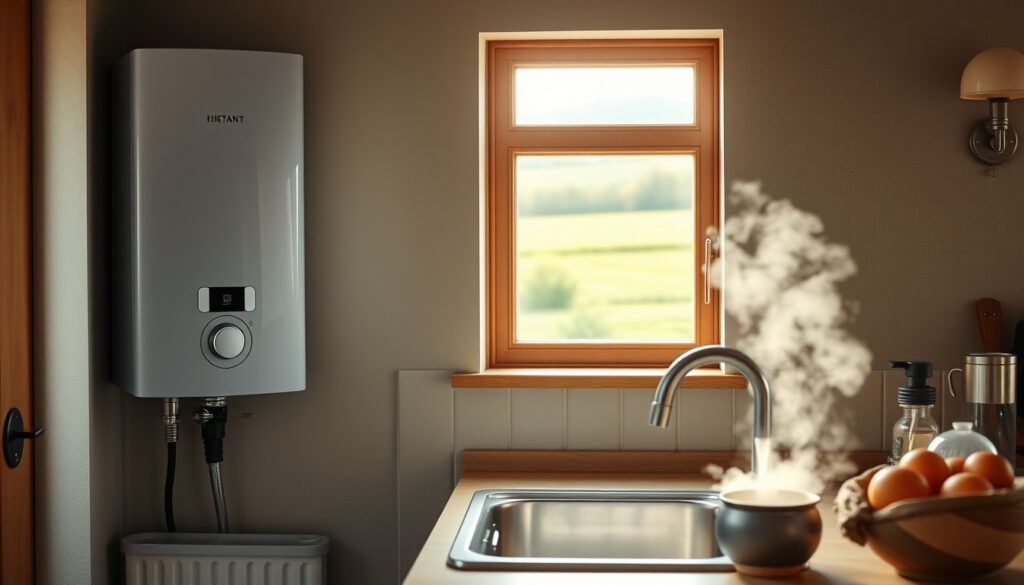
Instant Hot Water System: Pros, Cons & Ireland Guide
If you’ve ever waited forty seconds for a kettle to boil just to rinse a single pot, you already understand the appeal of an instant hot water system. The idea of boiling water on demand, right from your kitchen tap, sounds almost too convenient — but the reality involves trade-offs that matter, especially if you’re outfitting a typical Irish home. This guide cuts through the sales patter to give you a clear-eyed look at what’s actually worth it.
Power Range: 6-9.5kW · Hot Water Delivery: 3-5 seconds · Mount Type: Wall Mounted · Application: Single Outlet · Heating Method: On Demand
Quick snapshot
- Endless hot water on demand (PK Plumbing)
- Compact size saves under-sink space (PK Plumbing)
- Tankless heaters use 30-50% less energy than tank units (Family Handyman)
- Limited flow rate when multiple taps run (PK Plumbing)
- Higher upfront purchase and install cost (PK Plumbing)
- Requires qualified plumber for setup (PK Plumbing)
- Single outlet use in small homes (PK Plumbing)
- Point-of-use installation under sinks (Screwfix.ie)
- Households with cold mains supply (Screwfix.ie)
- Exact energy savings vary by model and usage pattern (Family Handyman)
- Long-term durability data from Irish households limited (HotWaterTaps.ie)
Technical specifications for typical point-of-use electric instantaneous heaters are summarised in the table below.
| Specification | Value |
|---|---|
| Power Output | 6-9.5kW |
| Heat Time | 3-5 seconds |
| Mounting | Wall |
| Control | Manual |
| Application | Instantaneous single point |
Are instant hot water systems worth it?
The value proposition depends entirely on how you use hot water. For a single-person household running one sink, point-of-use heaters deliver genuine convenience without wasted energy. For larger families expecting simultaneous showers and dishwashing, the math shifts unfavourably.
Pros of instant systems
Instant hot water systems heat water only when you turn the tap, eliminating the standby losses that plague traditional tanks. PK Plumbing notes these units provide endless hot water on demand without the risk of an empty tank mid-shower. The compact form factor also frees up under-sink storage—a genuine benefit in smaller Irish kitchens where every centimetre counts.
Tankless water heaters use 30-50% less energy than tank units, according to Family Handyman (home improvement authority). For Irish households paying higher per-unit energy costs, that efficiency gap matters on your winter bills — and an undersized unit running flat out to compensate will squander those savings.
Cons and limitations
The trade-off is straightforward: higher upfront costs. Purchase and professional installation typically run several hundred euro more than a straight tank replacement. Flow rate limits also constrain simultaneous use—run two taps at once and temperature can dip noticeably on single-point models.
The implication: if your household peak demand involves multiple outlets running concurrently, budget for either a larger-capacity unit or accept that you’ll need to stagger usage.
What are the disadvantages of instant hot water?
Beyond the headline price gap, several practical drawbacks deserve attention before you commit to a purchase.
Upfront and installation costs
Irish-market boiling taps like the HotWaterTaps.ie range start at €529 for a basic 3-in-1 model, rising to €1,240 for premium flex-tap options. Compare this to premium competitors like Quooker at €1,410+, and the value case for Irish-manufactured options strengthens considerably. Professional installation by a registered plumber adds further cost, though quotes vary by region and existing pipework complexity.
Performance in cold climates
The incoming water temperature in Ireland during winter months can drop to 5-8°C in unheated supply conditions. PK Plumbing warns that electric instantaneous heaters must work harder to reach target temperatures in these conditions, potentially reducing flow rates or requiring larger kW ratings than summer-only usage scenarios would suggest.
The catch: a unit undersized for winter conditions becomes a disappointment by December, regardless of how well it performed in July.
Does instant hot water use a lot of electricity?
Electric instant heaters draw significant power—typically 6 to 9.5kW at peak operation—but they only draw that power during active heating, not continuously.
Power consumption breakdown
Triton instant water heaters power up only when water flows through the unit, minimizing unnecessary energy use. Triton Showers (Irish supplier) confirms this on-demand activation pattern. The Grohe Red Duo boiling tap holds an A efficiency rating for hot water generation, according to Ideal Home (product review authority).
Daily energy use for boiling water taps is reportedly similar to a few kettle boils, HotWaterTaps.ie suggests, though independent Irish household testing data remains limited.
Comparison to tank systems
The efficiency advantage is real: tankless units heat only the water you use rather than maintaining a reservoir temperature around the clock. Family Handyman cites 30-50% energy savings compared to tank units, which translates to meaningful euro savings over a system’s operational lifetime.
For Irish homeowners facing rising electricity costs, the 30-50% efficiency gain from a tankless system is substantial—but only if the unit is properly sized for your household’s actual demand. An undersized heater running at full capacity to compensate erases those gains on your bill.
What this means: the true cost of electricity depends on your usage patterns. A single-person household boiling water twice daily may see minimal bill impact. A family running the dishwasher, washing machine, and multiple taps simultaneously will notice the higher draw when elements engage.
Can two people shower at the same time with a tankless water heater?
This is where buyer expectations most often collide with reality, and the honest answer requires context about your specific setup.
Flow rate capacities
Point-of-use electric instantaneous heaters like the Triton Instaflow are designed for single-outlet operation. Screwfix.ie lists this model specifically as suitable for one sink or shower at a time. Attempting to run two outlets simultaneously will likely result in lukewarm water or insufficient flow.
Sizing for households
Whole-house tankless heaters exist with higher kW ratings (typically 18-27kW for gas models), but these require significant gas supply upgrades and professional sizing calculations. 24 Hour Plumber IE notes that Combi boilers in Ireland provide instant hot water without storage cylinders, but these represent a whole-home solution rather than a point-of-use add-on.
The pattern: if you want true simultaneous multi-outlet capability, a point-of-use electric unit is not the right product. Consider Combi boiler upgrades or gas-fired whole-house tankless systems instead.
Why do plumbers not recommend tankless water heaters?
Professional scepticism exists for legitimate reasons—many plumbers have dealt with problematic installations that give the technology a bad name.
Common installation issues
PK Plumbing identifies installation complexity as a primary concern: these units often require electrical upgrades, new circuit runs, or modifications to existing pipework that a simple tank swap does not. Electrical regulations in Ireland require competent person certification for high-amperage circuits, limiting who can legally perform the work and potentially inflating installation costs.
Reliability concerns
Scale buildup represents the most common reliability issue in Irish homes with hard water supply. PK Plumbing notes that regular descaling maintenance is required, particularly for heating elements in areas with limestone-heavy water like Dublin, Cork, and Galway. Failure to maintain these units leads to efficiency loss and premature element failure.
The implication: a tankless water heater in a hard-water Irish household requires more ongoing maintenance than a straightforward storage tank. Factor these costs—and the effort of scheduling annual servicing—into your decision.
Boiling water tap options in Ireland
Four brands compete for Irish kitchen attention, with significant price stratification and feature differences worth understanding.
Irish-manufactured models from HotWaterTaps.ie undercut premium competitors significantly while offering comparable core functionality.
| Model | Price From | Key Features | Warranty |
|---|---|---|---|
| HotWaterTaps.ie Revista | €529 (€555) | 3-in-1: hot, cold, filtered boiling | 5 years tap, 2 years tank |
| HotWaterTaps.ie Helena | €575 | Adjustable 75°C-98°C temperature | 5 years tap, 2 years tank |
| HotWaterTaps.ie Quanta | €675 | Best-selling 4-in-1 with filtered cold | 5 years tap, 2 years tank |
| HotWaterTaps.ie Platina | €1240 | Flex tap with pull-out hose | 5 years tap, 2 years tank |
| Quooker | €1410+ | Premium brand, 4-in-1 options | Manufacturer varies |
| InSinkErator | Varies | Scored 78/100 in UK tests | Manufacturer varies |
The 4-in-1 models provide filtered cold water that 3-in-1 variants cannot, a practical distinction for households with children or anyone who drinks tap water directly. All HotWaterTaps.ie products include filter replacements at €35.95 every six months, with free 48-hour delivery nationwide.
Upsides
- Endless hot water on demand for single outlets
- Compact size frees under-sink storage space
- 30-50% energy savings versus tank systems
- Irish suppliers like HotWaterTaps.ie offer competitive pricing
- 5-year tap warranties provide purchase confidence
- Boiling taps are safer than kettles due to insulation and fixed installation
Downsides
- Higher upfront cost versus tank replacement
- Limited simultaneous use on single-point units
- Electrical upgrades may be required for installation
- Scale buildup risk in hard-water areas
- Filter replacement costs €35.95 every 6 months
- Undersized units underperform in cold Irish winters
Related reading: Beko Washing Machine Reviews · AGL Electricity Rates
Homeowners short on indoor space often explore outdoor hot water cylinders that handle Ireland’s rain and cold swings without issue.
Frequently asked questions
What is an instant hot water system?
An instant hot water system heats water on demand as it passes through the unit, rather than storing pre-heated water in a tank. This category includes electric instantaneous heaters installed under sinks and boiling water taps that provide near-boiling water directly from the tap. Both types eliminate standby heat loss and provide endless hot water within their flow rate limits.
How much does an instant hot water system cost in Ireland?
Boiling water taps range from €529 for basic 3-in-1 models from HotWaterTaps.ie to €1,240 for premium flex-tap options. Electric instantaneous heaters like the Triton Instaflow are available from retailers like Screwfix.ie, with prices varying by kW rating. Professional installation adds further cost depending on existing pipework and any electrical upgrades required.
Are instant hot water systems energy efficient?
Tankless water heaters use 30-50% less energy than traditional tank units by heating water only when needed rather than maintaining reservoir temperature. Family Handyman confirms this efficiency advantage. However, actual savings depend on household usage patterns and whether the unit is properly sized for demand.
Can instant water heaters work for shower and sink simultaneously?
Single-point electric instantaneous heaters are designed for one outlet at a time. Attempting simultaneous use typically results in reduced flow rates or lukewarm water. For households needing multi-outlet capability, whole-house tankless solutions or Combi boiler upgrades are more appropriate, though at significantly higher cost.
Do instant hot water systems need much maintenance?
Regular maintenance, particularly descaling, is required in areas with hard water. PK Plumbing confirms this maintenance requirement. Boiling water taps additionally require filter replacements every six months at approximately €35.95. Proper maintenance extends unit lifespan significantly but adds to the lifetime cost of ownership.
Is there a gas instant hot water boiler option?
Yes, gas-fired tankless or combi boilers provide instant hot water for whole-house applications. 24 Hour Plumber IE explains that Combi boilers in Ireland heat water on demand without storage cylinders, making them suitable for larger households with higher simultaneous demand requirements. These require gas supply connection and professional installation.
What is the best instant hot water system for Irish homes?
The best option depends on your household size, budget, and simultaneous use requirements. For single-outlet kitchen use, the HotWaterTaps.ie Quanta at €675 offers strong value with 4-in-1 functionality. For whole-house needs, Combi boiler upgrades provide the most reliable simultaneous delivery. The InSinkErator scored 78/100 in Good Housekeeping UK testing, providing an independent benchmark for comparison.
For Irish homeowners, the instant hot water verdict depends on honest self-assessment of your household’s usage patterns. Single-outlet point-of-use systems make genuine sense if you want kitchen boiling water without kettle hassle, have limited under-sink space, and are willing to budget for professional installation and occasional maintenance. For families expecting simultaneous multi-outlet performance, these units will disappoint—whole-house solutions or Combi boiler upgrades are the appropriate path instead.
What experts say
Instant hot water systems only heat water when you need it, which can save you money on energy bills.
— PK Plumbing (Plumbing Industry Blog)
Boiling water taps are significantly safer than kettles due to insulation and fixed installation.
— HotWaterTaps.ie (Irish Retailer)
Our Revista 3-in-1 starts at just €555, versus Quooker’s €1410+. That price gap makes Irish-manufactured options compelling for budget-conscious buyers.
— HotWaterTaps.ie (Irish Retailer)
For Irish homeowners, the instant hot water verdict depends on honest self-assessment of your household’s usage patterns. Single-outlet point-of-use systems make genuine sense if you want kitchen boiling water without kettle hassle, have limited under-sink space, and are willing to budget for professional installation and occasional maintenance. For families expecting simultaneous multi-outlet performance, these units will disappoint—whole-house solutions or Combi boiler upgrades are the appropriate path instead.
More related posts
 Jaswinder Bhalla Cause of Death: Brain Stroke at 65
 Dallas Cowboys 2026: Playoff Status, Dak Tragedy & Team Outlook
 Manon Katseye: Hiatus, Nationality, and What Happened
 Craig McRae: Biography, Salary, Family, and Coaching Career
 Ninja Air Fryer: Worth It? Model & Myth for Ireland
 Mel C: Relationship, Baby Daddy, Surgery, Net Worth & Career
 Amanda Holden: Biography, Family, Feuds, and Net Worth